
Modern software systems must handle growing numbers of users, simultaneous operations, distributed services, cloud environments, and strict performance requirements.
Developers therefore need programming languages that support efficient execution, clear application structure, concurrency, networking, and scalable software architecture.
The Go programming language—also known as Golang—was designed for these types of challenges.
Go combines a relatively simple syntax with powerful tools for building web services, backend systems, network applications, cloud-native platforms, developer tools, and concurrent software.
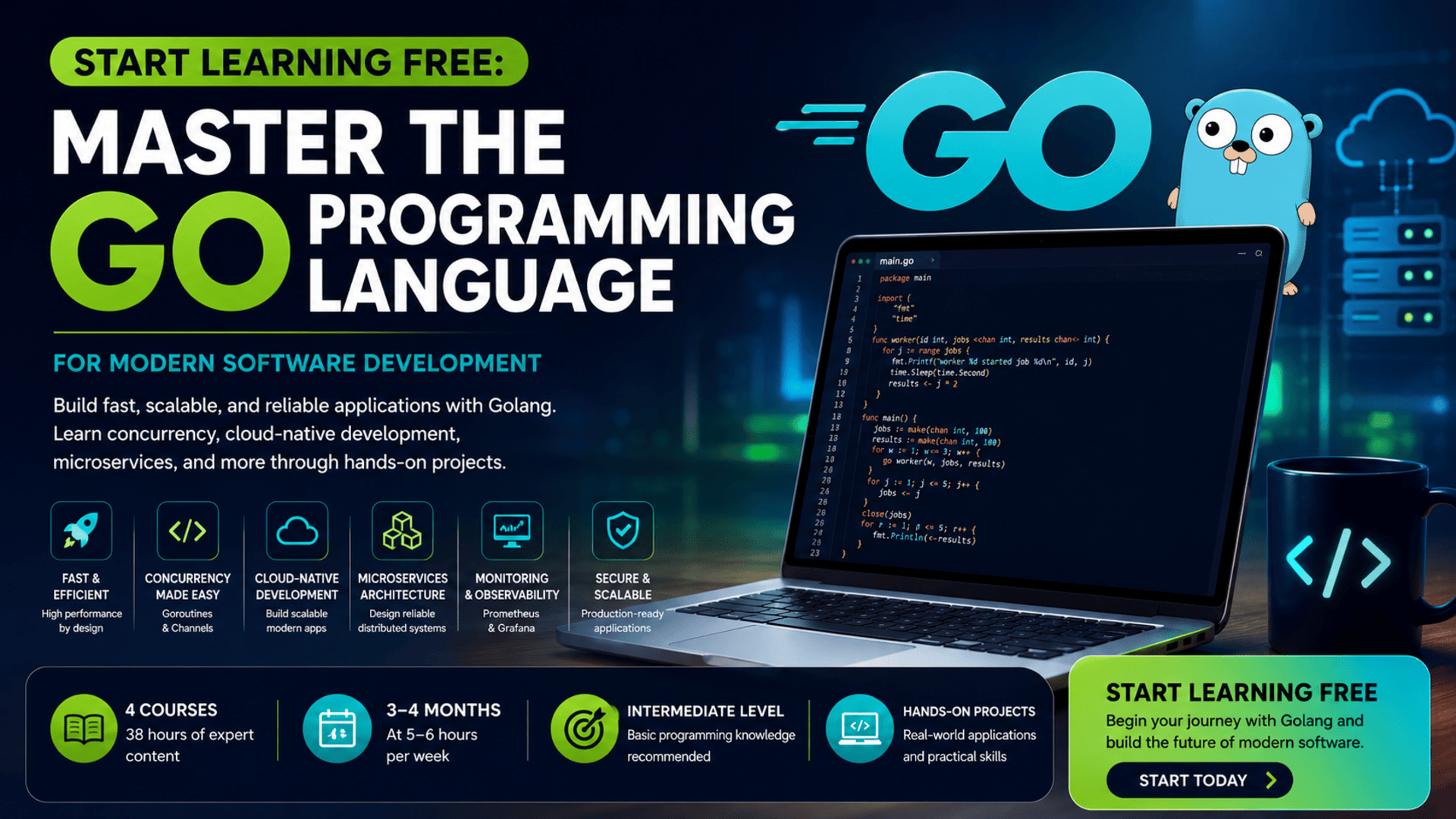
The Go Programming Language program provides a structured learning path from foundational syntax to advanced system-development concepts.
Across four connected courses, learners study Go variables, functions, libraries, reflection, metaprogramming, goroutines, synchronization, multithreading, microservices, monitoring, cloud-native architecture, performance optimization, and secure distributed applications.
You can begin by opening one of the individual courses and checking whether selected Preview materials are available to Start Learning Free before choosing a complete enrollment option.
What Is the Go Programming Language?
Go is a compiled programming language designed to support efficient and maintainable software development.
It is commonly used for:
- Backend services
- Web applications
- APIs
- Cloud infrastructure
- Microservices
- Networking tools
- DevOps platforms
- Distributed systems
- Command-line applications
- System utilities
- Monitoring tools
- High-performance services
Go is known for combining a concise syntax with features that support concurrency and system-level development.
Its standard tooling also helps developers format code, manage packages, run tests, build applications, and create documentation.
Why Learn Go for Modern Software Development?
Many modern applications must perform several operations at the same time.
A backend service may need to:
- Process multiple user requests
- Communicate with databases
- Call external APIs
- Write logs
- Run background tasks
- Share information between services
- Monitor system health
- Respond to network events
Go provides built-in concurrency features that help developers manage these workloads efficiently.
Learning Go can help you develop skills in:
- Backend engineering
- Concurrent programming
- Cloud-native development
- Microservices
- Network programming
- System programming
- Performance optimization
- DevOps automation
- Distributed applications
- Secure service development
These capabilities are useful for developers working on systems that need to remain fast, reliable, maintainable, and scalable.
About the Go Programming Language Program
This intermediate-level specialization contains four courses:
- Programming with Golang
- Advanced Golang Concepts
- Mastering Multithreading with Go
- Go for Cloud and Networks
The four courses provide approximately 38 hours of listed learning content:
- Programming with Golang: 14 hours
- Advanced Golang Concepts: 10 hours
- Mastering Multithreading with Go: 8 hours
- Go for Cloud and Networks: 6 hours
The recommended completion period is approximately three to four months when studying for five to six hours each week.
Basic programming experience is beneficial, although it is not presented as a strict requirement.
The course order is important because each stage builds on the concepts introduced earlier.
What Will You Learn?
The program covers both foundational and advanced Go development.
Key learning outcomes include:
- Understanding the Go development environment
- Writing and running Go programs
- Working with variables and data types
- Using loops and control structures
- Creating functions
- Working with Go libraries
- Organizing clean and idiomatic code
- Applying Go naming conventions
- Understanding error handling
- Building scalable applications
- Using interfaces
- Working with dynamic values
- Applying reflection
- Using the unsafe package
- Understanding metaprogramming
- Optimizing program performance
- Working with goroutines
- Using channels for communication
- Synchronizing concurrent operations
- Using mutexes
- Working with conditional variables
- Detecting race conditions
- Resolving deadlocks
- Applying atomic variables
- Understanding spinning locks
- Designing cloud-native applications
- Building microservices
- Applying event-driven orchestration
- Using the Gin web framework
- Monitoring services
- Working with Prometheus and Grafana
- Testing and scaling distributed services
- Building secure production-ready applications
Course Breakdown
Course 1: Programming with Golang
Estimated learning time: 14 hours
The first course introduces the Go programming language from the ground up.
Learners begin with the Go environment and core syntax before progressing into scalable application-development concepts.
Topics include:
- Go language features
- Development environments
- Variables
- Data types
- Arrays
- Slices
- Loops
- Control statements
- Functions
- Libraries
- Packages
- Error handling
- Clean code
- Naming conventions
- Application structure
Setting Up the Go Environment
A working development environment allows learners to create, run, debug, and test Go programs.
The setup may include:
- Installing Go
- Configuring a code editor
- Understanding the project structure
- Managing packages
- Running programs
- Using command-line tools
- Organizing source files
Variables and Data Types
Variables store information used by an application.
Examples include:
- User names
- Port numbers
- Application settings
- Request values
- Counters
- Response information
Understanding types helps developers create predictable programs and reduce errors.
Control Structures and Loops
Control structures allow programs to make decisions and repeat operations.
Learners explore how to:
- Evaluate conditions
- Repeat code
- Process collections
- Control application flow
- Handle different execution paths
Functions and Libraries
Functions organize reusable logic.
They may be used to:
- Process data
- Validate input
- Handle requests
- Perform calculations
- Communicate with services
- Return structured results
Go libraries and packages help developers organize applications and reuse functionality.
Writing Idiomatic Go
Professional Go development is not only about writing code that works.
Developers should also write code that is clear, concise, maintainable, and aligned with common Go conventions.
The course introduces:
- Clean naming
- Simple program structure
- Reusable functions
- Package organization
- Readable code
- Development best practices
Course 2: Advanced Golang Concepts
Estimated learning time: 10 hours
The second course moves into more advanced areas of the language.
Learners explore:
- Interfaces
- Dynamic values
- Reflection
- The unsafe package
- Metaprogramming
- Memory management
- Performance tuning
- Advanced software architecture
Interfaces in Go
Interfaces define behavior.
They allow different types to be used through a shared set of methods.
Interfaces can help developers create:
- Flexible functions
- Reusable application components
- Testable systems
- Loosely coupled services
- Replaceable implementations
This is valuable in large applications where different modules may need to follow the same behavior while using different internal logic.
Reflection
Reflection allows a program to examine and work with type information during execution.
It may be useful when developing:
- Serialization tools
- Frameworks
- Dependency systems
- Validation libraries
- Generic utilities
- Dynamic application behavior
Reflection can be powerful, but it should be used carefully because it can make code more complex.
The Unsafe Package
The unsafe package allows certain low-level operations that bypass some of Go’s normal safety controls.
It may be used in specialized performance or systems-programming scenarios.
Because unsafe operations can introduce risk, developers need to understand when they are appropriate and how to use them responsibly.
Metaprogramming
Metaprogramming refers to techniques where programs examine or generate structures dynamically.
Learners explore how advanced Go applications can use reflection and metadata to create flexible behavior.
These techniques may support:
- Framework development
- Automated configuration
- Dynamic validation
- Code-generation workflows
- Reusable system components
Performance Optimization
Advanced applications must often process more users, data, or concurrent operations.
Performance optimization may involve:
- Profiling
- Memory analysis
- Reducing unnecessary allocations
- Improving application architecture
- Selecting efficient data structures
- Simplifying expensive operations
The goal is to improve performance without making the code unnecessarily difficult to maintain.
Course 3: Mastering Multithreading with Go
Estimated learning time: 8 hours
The third course focuses on concurrency, parallelism, synchronization, and multithreading.
These concepts are among the most important reasons developers choose Go.
What Is Concurrency?
Concurrency allows a program to manage several tasks during the same period.
For example, a web service may:
- Process incoming requests
- Read from a database
- Write logs
- Send messages
- Update metrics
- Perform background work
Go uses goroutines to support lightweight concurrent operations.
Goroutines
A goroutine is a function that can run concurrently with other work.
Developers may use goroutines for:
- Background processing
- Parallel calculations
- Network requests
- Worker systems
- Event handling
- Service communication
Goroutines are designed to be lightweight compared with traditional operating-system threads.
Channels
Channels allow goroutines to communicate and exchange information.
They can help coordinate work without relying entirely on shared memory.
Channels may be used to:
- Send tasks
- Return results
- Coordinate workers
- Signal completion
- Process streams of information
- Control concurrent workflows
Mutexes and Synchronization
When multiple operations access the same data, developers must prevent unexpected conflicts.
Mutexes help protect shared resources so that only one operation modifies them at a time.
The course also introduces synchronization methods such as:
- Conditional variables
- Atomic variables
- Barriers
- Locks
- Spinning locks
Race Conditions and Deadlocks
A race condition occurs when application behavior depends on the unpredictable timing of concurrent operations.
A deadlock occurs when operations wait for one another indefinitely.
Learners explore how to:
- Identify concurrency problems
- Analyze thread behavior
- Protect shared information
- Avoid unsafe synchronization
- Build more reliable concurrent programs
These skills are essential when developing high-performance backend or system applications.
Course 4: Go for Cloud and Networks
Estimated learning time: 6 hours
The final course focuses on applying Go to cloud-native and network-based systems.
Learners explore:
- Cloud-native application design
- Microservices
- Event-driven architecture
- Service orchestration
- Networking
- Monitoring
- Testing
- Scalability
- Security
- Distributed applications
Cloud-Native Development
Cloud-native applications are designed to operate effectively in distributed and scalable environments.
They may use:
- Containers
- Microservices
- Automated deployment
- Monitoring
- Service discovery
- Event-driven communication
- Scalable infrastructure
Go is widely used for these environments because it supports efficient services and concurrent workloads.
Microservices Architecture
A microservices architecture divides an application into smaller services.
Each service may focus on one business responsibility.
For example:
- Authentication service
- Payment service
- Notification service
- Inventory service
- Reporting service
Services communicate through APIs, events, or messaging systems.
This approach can improve independent deployment and scalability, but it also introduces operational complexity.
Gin Framework
Gin is a web framework used to build Go web applications and APIs.
Developers can use it to create:
- API endpoints
- Routing
- Middleware
- Request validation
- JSON responses
- Web services
Understanding a Go web framework helps learners move from language fundamentals to production-oriented backend development.
Monitoring with Prometheus and Grafana
Production applications need monitoring.
Prometheus can collect operational metrics such as:
- Request counts
- Response times
- Error rates
- Memory usage
- Service health
Grafana can display this information through dashboards.
Monitoring helps teams identify problems, understand usage, and improve reliability.
Testing, Scaling, and Security
Cloud applications need to remain reliable as traffic increases.
Learners explore how to:
- Test services
- Monitor behavior
- Scale microservices
- Improve performance
- Protect network communication
- Build secure distributed applications
- Prepare software for production
Practical Learning and Real-World Projects
The program emphasizes applying Go concepts through practical development scenarios.
Learners may work on projects involving:
- Go syntax and functions
- Backend application logic
- Interfaces
- Reflection
- Concurrent programs
- Goroutines
- Channels
- Synchronization
- Web services
- Gin-based applications
- Cloud-native architecture
- Monitoring dashboards
- Microservices
- Performance analysis
Practical projects help learners move beyond theory and demonstrate how Go is used in real software systems.
Skills You Can Develop
Go Programming
Write structured, efficient, and maintainable Go applications.
Backend Development
Create server-side services, APIs, and application logic.
Concurrency
Use goroutines and channels to manage multiple operations.
Multithreading
Work with synchronization, mutexes, atomic operations, and shared data.
Software Architecture
Design flexible and scalable application structures.
Reflection and Metaprogramming
Build advanced dynamic application behavior.
Cloud-Native Development
Create software designed for distributed and scalable environments.
Microservices
Break applications into independently managed services.
Network Programming
Develop applications that communicate across systems and services.
Performance Optimization
Profile and improve program execution, memory usage, and concurrency.
Monitoring
Use metrics and dashboards to understand application health.
Security
Apply safer patterns to networked and distributed software.
Tools and Technologies Covered
The program introduces:
- Go
- Golang development environments
- Command-line tools
- Go packages
- Goroutines
- Channels
- Interfaces
- Reflection
- Gin
- Prometheus
- Grafana
- Cloud-native tools
- Monitoring platforms
- Testing tools
- Documentation tools
- Version-control systems
Who Should Take This Program?
This learning path may be suitable for:
Software Developers
Developers who want to add Go to their programming toolkit.
Backend Developers
Professionals interested in efficient server-side applications and web services.
DevOps Engineers
Engineers working with cloud infrastructure, automation, monitoring, and distributed platforms.
Cloud Engineers
Professionals who want to build services for cloud-native environments.
Network Engineers
Learners interested in networking, communication systems, and distributed applications.
System Programmers
Developers working close to operating systems, memory, and performance.
Computer Science Students
Students who want experience with programming, concurrency, architecture, and cloud systems.
Security Researchers
Professionals exploring secure, efficient, and networked software.
Is This Program Suitable for Beginners?
The program is listed as intermediate level, and basic programming knowledge is recommended.
However, the first course begins with Go fundamentals and does not require previous Go experience.
Learners who already understand variables, functions, conditions, loops, or another programming language may progress more easily.
Complete programming beginners may need additional time to practice foundational concepts before moving into reflection, multithreading, and cloud architecture.
How Long Does the Program Take?
The four courses contain approximately 38 hours of listed content:
- Programming with Golang: 14 hours
- Advanced Golang Concepts: 10 hours
- Mastering Multithreading with Go: 8 hours
- Go for Cloud and Networks: 6 hours
The recommended completion period is approximately three to four months at five to six hours per week.
Actual completion time depends on:
- Previous programming experience
- Weekly study time
- Project complexity
- Debugging requirements
- Additional practice
- Time spent building independent applications
Should You Complete the Courses in Order?
Yes.
The recommended sequence is:
- Programming with Golang
- Advanced Golang Concepts
- Mastering Multithreading with Go
- Go for Cloud and Networks
The first course builds the programming foundation.
The second introduces reflection, interfaces, metaprogramming, and performance.
The third focuses on concurrency and synchronization.
The final course applies these skills to cloud-native applications, microservices, networking, monitoring, and production systems.
How to Start Learning Free
The complete four-course specialization is not currently presented as entirely free.
However, you can check an individual course to see whether a Preview option is available.
Follow these steps:
- Open the program link.
- Scroll down until you find the four individual courses.
- Select the course you want to explore.
- Open the individual course page.
- Click Enroll.
- Sign in or create an account when requested.
- Look for a Preview option instead of selecting Start Free Trial or a paid enrollment plan.
- When Preview is displayed, open the available videos or learning materials and begin studying.
Preview availability may vary according to the course, location, account, and current enrollment settings.
Selected Preview access may not include:
- Every lesson
- Complete projects
- Graded assignments
- Assessments
- The full specialization
- The shareable certificate
When Preview is unavailable, check whether financial aid or a scholarship is offered.
“Start Learning Free” means using an available no-cost entry option. It does not mean that the full specialization and certificate are guaranteed to be free.
Can You Earn a Certificate?
A shareable career certificate is available after completing the required courses and assessments through an eligible enrollment option.
The certificate may be added to:
- A LinkedIn profile
- A resume
- A CV
- A software-development portfolio
- A performance review
- A personal learning record
Preview access does not provide the complete certificate.
For stronger career results, combine the credential with working Go applications, source-code repositories, tests, and project documentation.
How to Build a Strong Go Portfolio
Consider creating projects such as:
- A REST API
- A URL-shortening service
- A concurrent web crawler
- A worker-pool application
- A command-line tool
- A monitoring service
- A Gin web application
- A microservices demo
- A network scanner
- A cloud-native backend service
Each portfolio project should include:
- A clear purpose
- Clean Go code
- Package organization
- Error handling
- Concurrency where appropriate
- Tests
- Documentation
- Performance notes
- Security considerations
- A source-code repository
- Deployment instructions
A well-documented portfolio demonstrates that you can apply Go to realistic development challenges.
Frequently Asked Questions
Can I Start Learning Free?
You can check individual course pages for a Preview option. When available, Preview may provide selected videos or learning materials.
Is the complete Go specialization free?
No. The full four-course program, projects, graded work, and certificate are not currently presented as entirely free.
How many courses are included?
The specialization contains four courses covering Go programming, advanced Golang concepts, multithreading, concurrency, cloud development, and networks.
Is previous programming experience required?
Basic programming knowledge is recommended, but prior Go experience is not required.
Will I learn goroutines and channels?
Yes. The concurrency course covers goroutines, channels, synchronization, race conditions, and deadlocks.
Will I learn cloud-native development?
Yes. The final course covers cloud-native architecture, microservices, monitoring, scalability, and distributed applications.
Does the program cover the Gin framework?
Yes. Gin is included as a framework for developing Go web applications and services.
Will I learn Prometheus and Grafana?
Yes. The curriculum includes monitoring tools such as Prometheus and Grafana.
Does the program cover performance optimization?
Yes. Learners explore profiling, memory management, concurrency performance, and scalable architecture.
How long does the program take?
The recommended duration is approximately three to four months at five to six hours per week.
Can Preview access provide a certificate?
No. Preview access does not include the complete shareable certificate.
Start Building Fast and Scalable Applications with Go
Go combines a concise programming model with powerful concurrency and system-development capabilities.
This four-course learning path progresses from Go fundamentals to reflection, metaprogramming, multithreading, microservices, monitoring, cloud-native architecture, and secure distributed applications.
Open one of the individual courses and check whether selected Preview materials are available.
Start Learning Free today and begin developing the Go programming skills needed to build fast, scalable, concurrent, and production-ready software.
Modern Backend and Cloud Development
Master the Go Programming Language
Learn Golang fundamentals, interfaces, reflection, goroutines, channels, multithreading, Gin, microservices, cloud-native development, Prometheus, Grafana, and performance optimization.
Start Learning FreePreview availability and included materials may vary. Selected Preview access may not include the complete specialization, projects, graded assessments, or shareable certificate. Financial aid may be available for eligible learners. This page may contain a promotional link.