
Python is one of the best programming languages for beginners because it is simple to read, practical to use, and powerful enough for real-world projects in automation, data analysis, web development, artificial intelligence, APIs, databases, and software development.
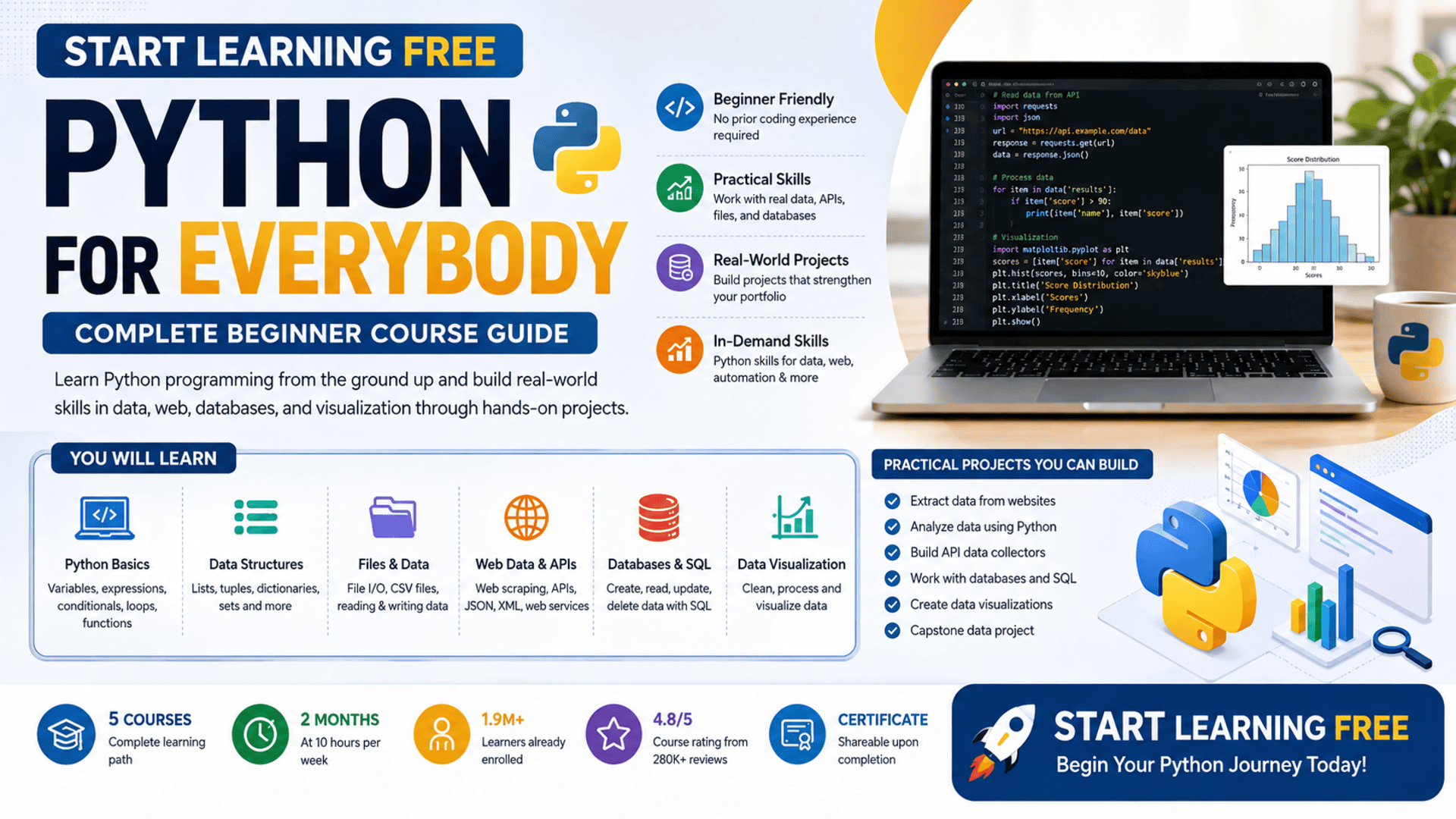
The Python for Everybody Complete Beginner Course Guide is designed for learners who want to start programming from the beginning and gradually build practical skills in Python, data structures, files, web data, APIs, databases, SQL, and data visualization.
You can start learning free by opening one of the individual courses and checking whether preview lessons are available before choosing complete enrollment.
What Will You Learn?
This learning path helps learners build practical Python skills in:
- Python programming fundamentals
- Software installation
- Variables and expressions
- Conditional statements
- Loops and functions
- Lists, tuples, and dictionaries
- File input and output
- Data structures
- Data processing
- Regular expressions
- Web scraping
- APIs and web services
- JSON and XML
- Network protocols
- Databases and SQL
- Object-oriented Python basics
- Data retrieval
- Data cleaning
- Data visualization
- Capstone project development
These skills can help beginners move from simple Python syntax to real data retrieval, processing, storage, and visualization workflows.
Courses Included in the Program
1. Programming for Everybody: Getting Started with Python
Start with the foundations of Python programming.
This course introduces Python installation, basic syntax, variables, expressions, conditional execution, functions, loops, and the core programming tools beginners need to write their first programs.
It is a strong starting point for learners with no previous programming experience.
2. Python Data Structures
Build stronger Python skills by learning how to organize and process data.
This course covers lists, dictionaries, tuples, file reading, file writing, sorting, looping through data, and using Python data structures to solve multi-step problems.
These topics are important because real programs often need to store, retrieve, organize, and transform information.
3. Using Python to Access Web Data
Learn how Python can collect and process information from the web.
This course introduces regular expressions, web protocols, APIs, HTML, XML, JSON, web services, and methods for retrieving data from websites and online systems.
These skills are useful for learners interested in automation, data analysis, web scraping, and API-based applications.
4. Using Databases with Python
Go deeper into how Python connects with databases and structured data.
This course covers CRUD operations, SQL, relational databases, database design, object-oriented Python basics, data modeling, and using APIs to visualize data.
It helps learners understand how data can be stored, queried, updated, and connected to Python applications.
5. Capstone: Retrieving, Processing, and Visualizing Data with Python
Apply your Python skills in a final project.
This course focuses on retrieving data, processing selected datasets, working with strings and unicode, understanding search engine basics, and creating visualizations from processed data.
The capstone helps learners connect programming, data processing, and visualization into a practical end-to-end workflow.
Practical Projects You Can Build
During this learning path, learners can practise through projects such as:
- Basic Python programs
- File processing scripts
- Dictionary-based data tools
- Web data extraction projects
- API data collection tools
- JSON and XML parsing projects
- SQL database projects
- Data cleaning workflows
- Data visualization outputs
- Capstone data retrieval and processing projects
These projects help beginners apply Python in practical situations instead of only learning theory.
Who Should Take This Course?
This course guide is suitable for:
- Complete programming beginners
- Python beginners
- Students learning computer science
- Data analysis beginners
- Automation learners
- Web data learners
- Career changers entering technology
- Business professionals who want coding skills
- Anyone who wants a practical introduction to Python and data
No prior programming experience is required, making it a strong starting point for motivated beginners.
Why Python for Everybody Skills Matter
Python is widely used in data analysis, automation, web applications, scripting, databases, APIs, machine learning, business workflows, and software development.
Learning Python can help beginners understand how programs work, how data is stored, how online information is collected, how APIs return data, and how databases support real applications.
This makes Python a valuable foundation for future learning paths such as data science, AI, backend development, automation, analytics, and software engineering.
How to Start Learning Free
Follow these steps to check for available preview lessons:
- Open the course guide link below.
- Scroll down and select one of the individual courses inside the program.
- Open the course you selected.
- Click Enroll.
- After signing in, choose Preview instead of Start Free Trial when available.
- You can now watch the available preview lessons and start learning for free.
Preview availability may vary. Complete lessons, assignments, certificates, and full program access may require paid enrollment. If preview access is unavailable, check whether financial aid is offered.
Build Practical Python and Data Skills
Learning Python is not only about writing code. It is about understanding how to solve problems, work with data, automate tasks, connect to online services, manage databases, and build practical projects.
This course guide gives beginners a structured path to start with Python basics and continue toward data structures, files, APIs, JSON, XML, SQL, databases, data processing, and visualization.
Start Learning Python for Everybody
Explore Python basics, data structures, files, APIs, JSON, XML, databases, SQL, web scraping, data processing, and practical data visualization projects.
Start Learning FreePreview availability and included learning materials may vary.