Start Learning Free: Become a Meta Back-End Developer and Build Job-Ready Server-Side Development Skills

Modern websites and mobile applications depend on powerful systems that users rarely see.
When someone signs into an account, submits an order, retrieves stored information, books an appointment, or sends a request through an application, the back end processes that action behind the scenes.
Back-end developers build and maintain the servers, databases, APIs, security controls, and application logic that make digital products work.
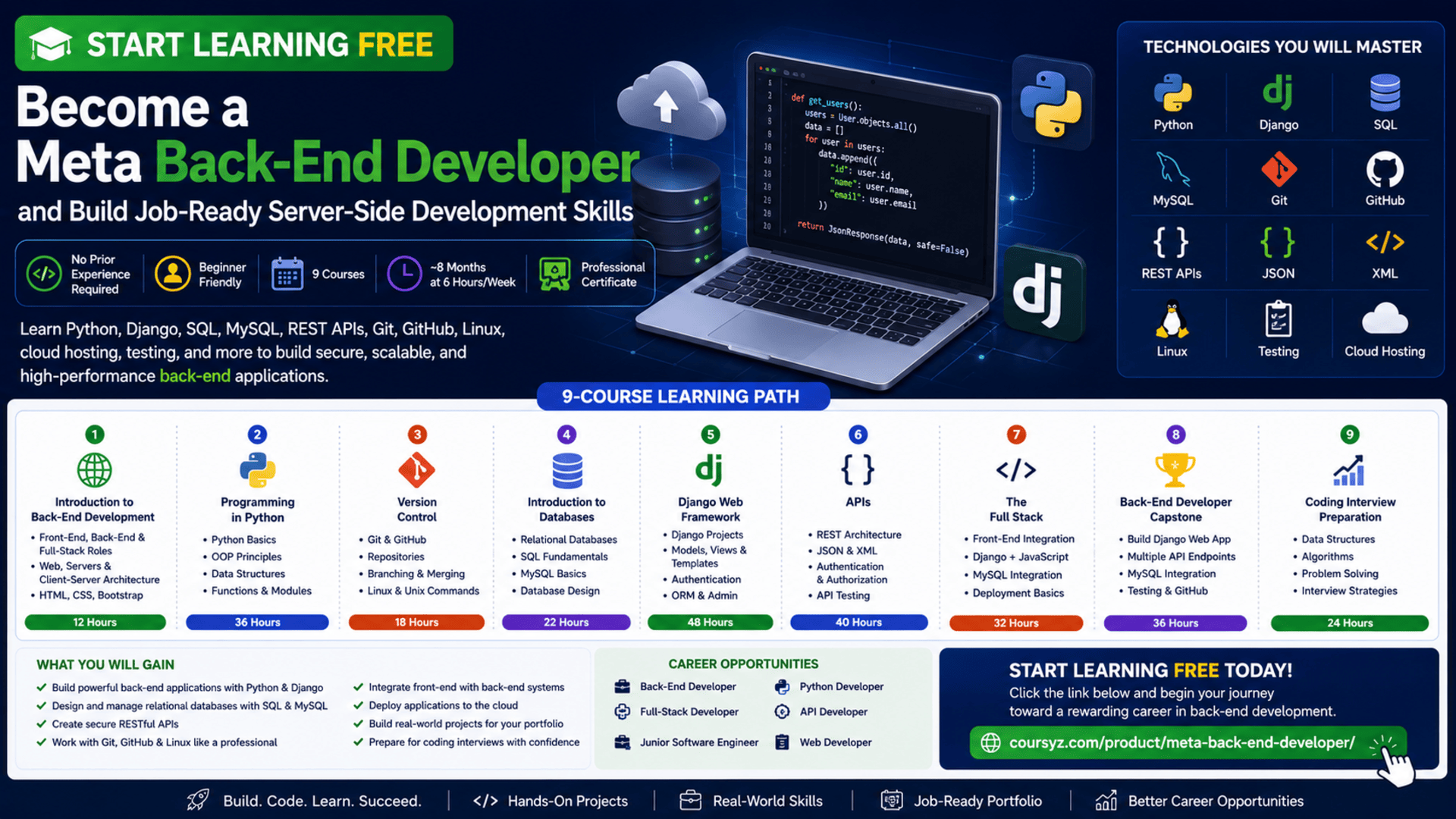
The Meta Back-End Developer Professional Certificate provides a structured learning path for beginners who want to develop practical server-side programming skills and prepare for entry-level opportunities in back-end or full-stack development.
You may be able to start learning free by opening an individual course inside the program and checking whether the Preview option is available. Preview access can help you explore selected lessons before deciding whether you need complete access to assessments, projects, the capstone, and the professional certificate.
Throughout the program, you will study Python, Linux commands, Git, GitHub, SQL, relational databases, Django, REST APIs, JSON, XML, cloud hosting, application security, testing, full-stack development, and technical-interview preparation.
Why Learn Back-End Development?
The back end is the technical foundation behind most digital applications.
It manages tasks such as:
- Processing user requests
- Storing and retrieving information
- Authenticating users
- Applying business rules
- Connecting applications to databases
- Creating and managing APIs
- Protecting sensitive data
- Handling transactions
- Supporting front-end interfaces
- Preparing applications for hosting and deployment
For example, when a customer places an order through an online store, the back end may:
- Confirm the user’s identity.
- Validate the order.
- Check inventory.
- Calculate the total.
- Save the transaction.
- Update the database.
- Send a response to the front end.
- Trigger a confirmation message.
Without reliable back-end development, the visible interface cannot deliver a complete user experience.
About the Meta Back-End Developer Professional Certificate
The Meta Back-End Developer Professional Certificate is a beginner-friendly, nine-course program designed to build practical and job-relevant development skills.
The suggested completion time is approximately eight months when studying around six hours per week.
The program follows a flexible, self-paced format, allowing learners to study according to their own schedules.
No degree or previous professional development experience is required.
The learning path introduces:
- Web-development fundamentals
- Python programming
- Version control
- Relational databases
- SQL
- Django
- Web frameworks
- REST APIs
- Application security
- Full-stack integration
- Back-end testing
- Cloud hosting
- A portfolio-ready capstone
- Coding-interview preparation
What You Will Learn
By following the complete program, you can learn how to:
- Explain the role of a back-end developer
- Understand client-server architecture
- Write Python programs
- Use variables, loops, functions, and conditions
- Apply object-oriented programming
- Work with Linux and Unix commands
- Manage code using Git and GitHub
- Create and query relational databases
- Write SQL statements
- Design database tables and relationships
- Build web applications with Django
- Use Django models, views, and templates
- Create RESTful APIs
- Work with JSON and XML
- Apply authentication and authorization
- Test API endpoints
- Connect a Django application to MySQL
- Combine front-end and back-end technologies
- Prepare applications for cloud hosting
- Build a practical capstone project
- Prepare for technical interviews
Course 1: Introduction to Back-End Development
The first course introduces the world of web development and explains the responsibilities of front-end, back-end, and full-stack developers.
You will learn how websites and web applications operate and explore the technologies that support the internet.
Topics include:
- Front-end development
- Back-end development
- Full-stack development
- Web servers
- Client-server architecture
- HTML
- CSS
- JavaScript
- React
- Bootstrap
- Responsive web design
- Web-development frameworks
You will also create and style a basic webpage using HTML, CSS, and Bootstrap.
Understand the Back-End Developer Role
Back-end developers focus on the server-side systems that support websites and applications.
Their responsibilities may include:
- Creating application logic
- Building APIs
- Managing databases
- Processing requests
- Applying security controls
- Testing server-side functionality
- Improving performance
- Managing application environments
- Supporting deployment
They often collaborate with front-end developers, database specialists, designers, testers, security professionals, and product teams.
Course 2: Programming in Python
Python is one of the main programming languages used throughout the program.
It is widely used in:
- Web development
- Automation
- Data analysis
- Artificial intelligence
- Machine learning
- Scripting
- Testing
- Server-side development
The course introduces:
- Python syntax
- Variables
- Data types
- Operators
- Conditional statements
- Loops
- Functions
- Lists
- Dictionaries
- Sets
- Tuples
- Exception handling
- Object-oriented programming
- Modules and packages
Why Python Is Valuable for Back-End Development
Python has readable syntax and a large ecosystem of libraries and frameworks.
It allows developers to:
- Create server-side logic
- Process user requests
- Connect to databases
- Build APIs
- Automate tasks
- Test applications
- Work with Django
- Integrate external services
A strong Python foundation is essential before progressing into Django and API development.
Apply Object-Oriented Programming
Object-oriented programming helps developers organize code into reusable classes and objects.
Key principles include:
Encapsulation
Encapsulation protects internal data and controls how it can be accessed.
Inheritance
Inheritance allows one class to reuse or extend another class.
Polymorphism
Polymorphism allows related objects to behave differently through a shared interface.
Abstraction
Abstraction hides unnecessary implementation details and exposes only what other parts of the application need.
These principles help make back-end applications easier to maintain and expand.
Course 3: Version Control
Modern development teams rely on version-control systems to manage code safely.
This course introduces:
- Git
- GitHub
- Repositories
- Commits
- Branches
- Merging
- Pull requests
- Command-line tools
- Linux and Unix commands
- Collaborative workflows
Why Git and GitHub Matter
Version control allows developers to:
- Track code changes
- Restore older versions
- Experiment in separate branches
- Collaborate with other developers
- Review proposed updates
- Resolve conflicts
- Publish open-source projects
- Build a visible portfolio
GitHub can also help employers evaluate your project structure, documentation, coding activity, and collaboration skills.
Course 4: Introduction to Databases for Back-End Development
Most back-end applications depend on databases.
Databases store information such as:
- User accounts
- Products
- Orders
- Transactions
- Messages
- Reservations
- Application settings
- Activity logs
This course introduces:
- Relational databases
- SQL
- MySQL
- Database design
- Tables
- Rows and columns
- Primary keys
- Foreign keys
- Data integrity
- Database relationships
- Query languages
- Database-management systems
Learn SQL
SQL is used to communicate with relational databases.
You may use SQL to:
- Create tables
- Insert records
- Retrieve data
- Update information
- Delete records
- Filter results
- Sort results
- Join multiple tables
- Aggregate information
Example:
SELECT name, email
FROM customers
WHERE account_status = 'active';
Understanding SQL is essential for building data-driven back-end systems.
Understand Database Relationships
Relational databases connect information across multiple tables.
Examples include:
- One customer can place many orders
- One order can contain many products
- One employee belongs to one department
- Many students can enroll in many courses
Developers must understand how to design these relationships and maintain data integrity.
Course 5: Django Web Framework
Django is a Python framework used to build secure and maintainable web applications.
It provides tools for:
- URL routing
- Templates
- Forms
- Models
- Authentication
- Database access
- Administration
- Security
- Application structure
The course introduces:
- Django projects
- Django applications
- Models
- Views
- Templates
- URL patterns
- Forms
- Object-relational mapping
- User accounts
- Authentication
- Web-application architecture
Why Learn Django?
Django helps developers avoid rebuilding common application features from the beginning.
It supports:
- Rapid development
- Organized project structure
- Database integration
- Built-in security features
- Authentication
- Administration tools
- Scalable application design
Developers can use Django to create content platforms, booking systems, business applications, APIs, dashboards, and e-commerce services.
Understand the Model-View-Template Pattern
Django uses a structured architecture commonly described as Model-View-Template.
Model
The model manages application data and database relationships.
View
The view processes requests and determines what response should be returned.
Template
The template controls how information is presented to users.
Separating these responsibilities makes applications easier to understand, test, and maintain.
Course 6: APIs
APIs allow systems and applications to communicate.
A front-end interface may send a request to a back-end API. The server processes the request and returns a response, often in JSON format.
This course covers:
- REST architecture
- RESTful APIs
- HTTP methods
- API endpoints
- JSON
- XML
- Authentication
- Authorization
- Status codes
- API testing
- Security
- Django REST Framework
Understand Common HTTP Methods
REST APIs commonly use:
GET
Retrieve information.
POST
Create a new resource.
PUT or PATCH
Update existing information.
DELETE
Remove a resource.
These actions often correspond to CRUD operations: create, read, update, and delete.
Work with JSON
JSON is commonly used to exchange data between front-end and back-end systems.
Example:
{
  "customer_id": 105,
  "name": "Alex Smith",
  "account_status": "active"
}
A back-end application may receive JSON, validate it, process it, save information in a database, and return another JSON response.
Apply API Authentication and Authorization
APIs often need to verify both identity and permissions.
Authentication confirms who the user is.
Authorization determines what that user is allowed to do.
For example:
- A customer may access their own orders
- A manager may update inventory
- An administrator may manage user accounts
Secure APIs should also apply input validation, encrypted connections, controlled permissions, error handling, and safe credential management.
Course 7: The Full Stack
This course gives learners an opportunity to combine front-end and back-end skills in one application.
You will build a full-stack Django application that may include:
- HTML
- CSS
- JavaScript
- Django
- Forms
- API endpoints
- MySQL
- Models
- Responsive pages
- Server-side logic
- Application environments
You will also learn about environments used during application development and deployment.
Connect the Front End and Back End
A typical full-stack interaction may work as follows:
- The user submits a form.
- The browser sends a request.
- Django receives the request.
- Server-side logic validates the data.
- The application reads or updates the database.
- The server returns a response.
- The interface displays the result.
Understanding this complete process helps back-end developers collaborate more effectively with front-end teams.
Prepare Applications for Hosting
Applications often move through several environments:
- Local development
- Testing
- Staging
- Production
Each environment may have different:
- Databases
- Configuration values
- Credentials
- Debug settings
- Hosting requirements
- Security controls
Developers must learn how to manage these differences safely.
Course 8: Back-End Developer Capstone
The capstone allows you to demonstrate multiple skills in a practical project.
You will build a Django web application with:
- Multiple API endpoints
- MySQL database integration
- User accounts
- Authentication
- Database models
- RESTful services
- Unit tests
- Version control
- Application logic
- API testing
The project is based on a realistic development scenario and can become part of your professional portfolio.
Why the Capstone Matters
A completed capstone can demonstrate that you know how to:
- Structure a Django application
- Design database models
- Create API endpoints
- Connect Django to MySQL
- Manage user accounts
- Test server-side functionality
- Use Git
- Document an application
- Solve practical development problems
To make the project stronger, customize it with your own design, features, business rules, and documentation.
Course 9: Coding Interview Preparation
The final course focuses on preparing for technical interviews.
Topics may include:
- Data structures
- Algorithms
- Pseudocode
- Problem-solving
- Computational thinking
- Coding exercises
- Technical communication
- Interview strategies
- Software-design concepts
You will practise explaining how you approach a problem, not only producing a final answer.
Hands-On Projects and Portfolio Development
The program emphasizes applied learning.
You may complete projects involving:
- Responsive webpages
- Python programs
- GitHub repositories
- SQL queries
- Database design
- Django applications
- REST APIs
- API testing
- User authentication
- MySQL integration
- Full-stack applications
- A back-end capstone
These projects can help you build a portfolio that demonstrates your technical development skills.
Tools and Technologies Covered
The program introduces:
- Python
- Django
- Django REST Framework
- SQL
- MySQL
- Git
- GitHub
- Linux commands
- Unix commands
- HTML
- CSS
- JavaScript
- Bootstrap
- REST APIs
- JSON
- XML
- Object-relational mapping
- Cloud hosting
- API testing
- Unit testing
Who Should Take This Program?
The certificate may be suitable for:
Complete Beginners
No previous professional programming experience is required.
Career Changers
Professionals interested in entering technology can follow a structured path toward back-end development.
Students and Recent Graduates
Students can complement academic studies with practical projects and portfolio work.
Front-End Developers
Front-end developers can learn how server-side applications, APIs, and databases work.
Aspiring Full-Stack Developers
The program includes both back-end skills and a full-stack integration course.
Freelancers
Freelancers can use these skills to create APIs, databases, server-side applications, and complete web systems.
Entrepreneurs
Entrepreneurs can develop a stronger understanding of how web applications are structured, secured, hosted, and maintained.
How to Start Learning Free
You may be able to explore selected lessons before paying for the complete certificate experience.
Follow these steps:
- Open the program page using the call-to-action button in this article.
- Scroll down to the list of individual courses.
- Select the course you want to explore.
- Open the individual course page.
- Click Enroll.
- Sign in or create an account.
- Choose Preview instead of Start Free Trial, when available.
- Open the included videos and start learning free.
Important Access Notice
Preview availability may vary according to:
- The individual course
- Your account
- Your country
- Your device
- Current enrollment options
Preview access may not include graded assignments, all projects, the capstone, instructor support, or the professional certificate.
Always review the current payment and enrollment information before confirming.
How to Get the Best Results
Practise Python Regularly
Write small programs involving functions, loops, conditions, collections, and classes.
Use Git from the Beginning
Create a repository for every major project.
Practise SQL Independently
Build small databases and write your own queries.
Build Django Projects
Create applications such as:
- Customer-management system
- Booking platform
- Inventory service
- Help-desk application
- Restaurant API
- Task-management platform
Create REST APIs
Practise building, documenting, testing, and securing API endpoints.
Write Tests
Test models, views, APIs, validation rules, and permissions.
Document Your Projects
Include:
- Project overview
- Technologies
- Database schema
- API endpoints
- Installation instructions
- Authentication details
- Test instructions
- Known limitations
- Future improvements
Prepare for Interviews
Practise coding problems and explain your reasoning clearly.
Potential Career Opportunities
After developing sufficient skills and a strong portfolio, learners may explore roles such as:
- Junior back-end developer
- Python developer
- Django developer
- API developer
- Web application developer
- Junior software engineer
- Database application developer
- Full-stack development intern
- Application support developer
- Freelance back-end developer
Completing the certificate does not guarantee employment.
Employers may also evaluate:
- Python proficiency
- Django knowledge
- SQL skills
- API-development experience
- Git usage
- Testing ability
- Security awareness
- Portfolio quality
- Problem-solving
- Technical interview performance
Frequently Asked Questions
Can I start learning free?
You may be able to preview selected lessons by opening an individual course and choosing Preview when the option is available.
Is previous programming experience required?
No. The certificate is designed for beginners.
How many courses are included?
The current program contains nine courses.
How long does the program take?
The suggested completion time is approximately eight months at around six hours per week.
Does the program teach Python?
Yes. Python programming is a major part of the curriculum.
Will I learn Django?
Yes. You will build server-side web applications using Django.
Are databases included?
Yes. The program covers relational databases, SQL, MySQL, database design, and data integrity.
Does the certificate cover APIs?
Yes. You will learn REST APIs, JSON, XML, authentication, authorization, and API testing.
Is full-stack development included?
Yes. One course focuses on combining front-end technologies with Django and MySQL.
Will I build a capstone project?
Yes. The capstone requires a Django application with multiple API endpoints and MySQL database integration.
Is interview preparation included?
Yes. The final course covers coding challenges, algorithms, data structures, and technical communication.
Does Preview access include the certificate?
No. Preview access generally does not include the complete graded experience or the professional certificate.
Start Learning Free and Build Job-Ready Back-End Development Skills
Learn Python, Django, SQL, MySQL, Git, GitHub, Linux commands, REST APIs, JSON, XML, testing, cloud hosting, full-stack integration, and coding-interview preparation.
Open an individual course and look for the Preview option. Availability and included materials may vary. Complete courses, graded projects, the capstone, and the professional certificate may require paid enrollment.