
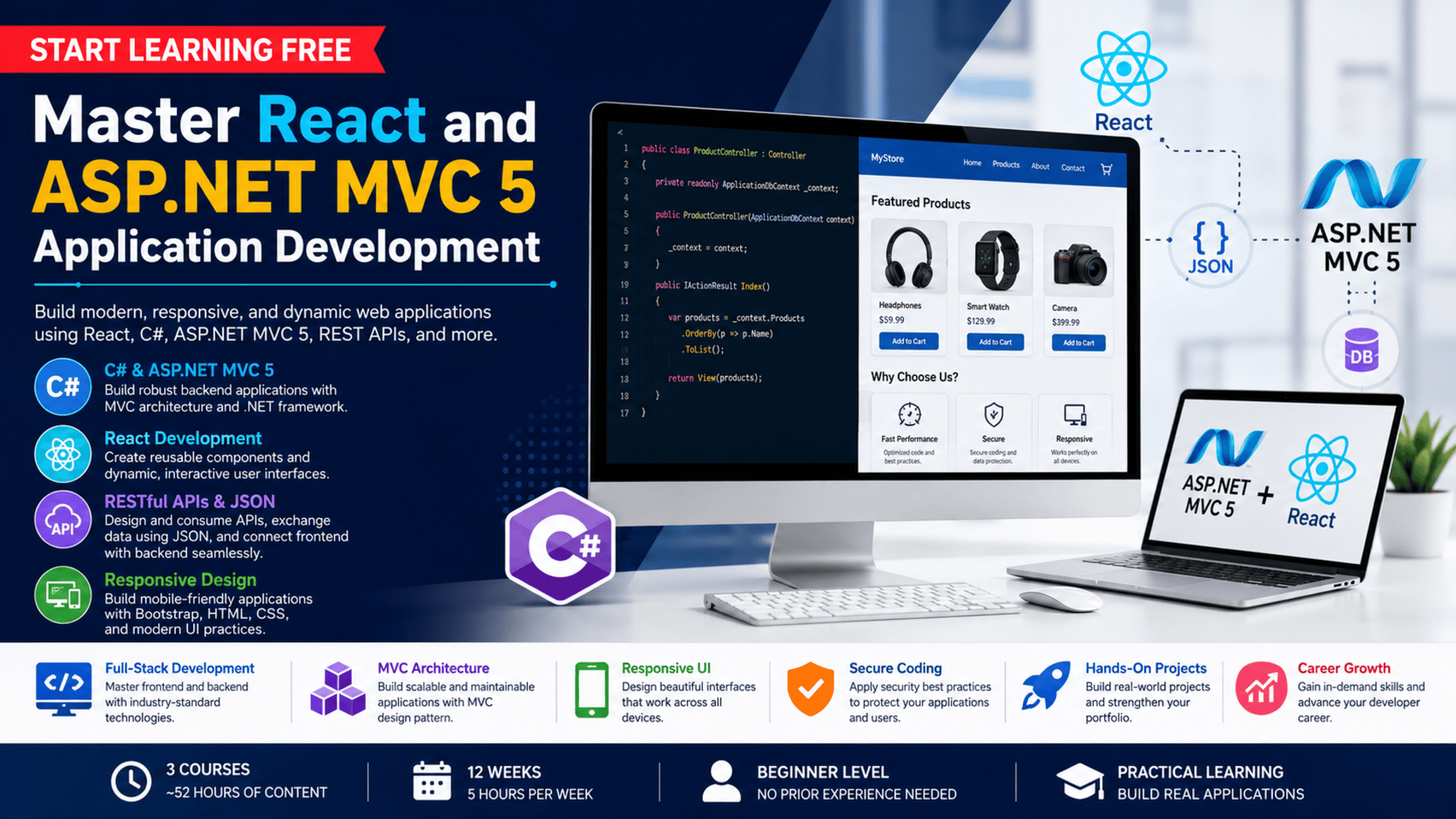
Modern web applications combine responsive user interfaces, structured backend systems, reusable components, data services, secure application logic, and smooth communication between the frontend and server.
Learning only one side of web development can limit what you are able to build.
Frontend developers need to understand how their interfaces receive and update data. Backend developers benefit from understanding how users interact with the services and application logic they create.
The Building React and ASP.NET MVC 5 Applications program introduces both sides of modern web application development.
Across three connected courses, learners study C# and ASP.NET fundamentals, explore React for building dynamic user interfaces, and then combine both technologies in a complete responsive application.
You may also be able to Start Learning Free by opening one of the individual courses and checking whether selected Preview materials are available.
What Is Full-Stack Web Application Development?
Full-stack development covers both the user-facing interface and the server-side systems behind a web application.
The frontend is responsible for what users see and interact with, including:
- Page layouts
- Forms
- Buttons
- Navigation
- Interactive components
- Responsive behavior
- Dynamic content
- User experience
The backend is responsible for areas such as:
- Application logic
- Data processing
- Authentication
- Routing
- Database communication
- APIs
- Security
- Server-side operations
In this learning path, React supports frontend interface development, while C#, ASP.NET, and MVC architecture support backend and application development.
Connecting these technologies allows developers to create complete applications instead of isolated website pages.
About the React and ASP.NET MVC 5 Program
This beginner-level specialization contains three courses designed to introduce modern frontend and backend development progressively.
The current recommended schedule is approximately 12 weeks at five hours per week.
The three courses provide about 52 hours of listed learning material:
- ASP.NET Core Foundation — 16 hours
- React Fundamentals — 17 hours
- Building React Application Using ASP.NET MVC 5 — 19 hours
The schedule is flexible, allowing learners to progress at their own pace.
The program begins with programming and backend foundations before introducing React components and user-interface development. The final course brings both areas together through React and ASP.NET MVC 5 integration.
The curriculum is strongly focused on applied learning and practical web-development scenarios.
Who Should Take This Program?
This program may be suitable for several types of learners.
Complete Beginners
The learning path begins with foundational C#, .NET, ASP.NET, and React concepts before moving into full-stack integration.
Aspiring Full-Stack Developers
Learners who want to understand both frontend and backend web application development.
Frontend Developers
React developers who want to learn how their interfaces connect with ASP.NET applications, APIs, routing, and server-side logic.
Backend Developers
C# or ASP.NET developers who want to add modern React user-interface skills to their technical toolkit.
Software Engineering Students
Students who want practical experience with object-oriented programming, MVC architecture, React, APIs, and responsive web applications.
Career Changers
Professionals exploring web development and looking for a structured path that covers both application layers.
Freelance Developers
Freelancers who want to build complete business websites, portals, dashboards, and data-driven applications.
Developers Updating Existing Skills
Developers familiar with traditional server-rendered applications who want to explore component-based frontend development.
What Will You Learn?
The specialization is designed to help learners create modern web applications using React and ASP.NET technologies.
Major learning outcomes include:
- Understanding C# programming fundamentals
- Applying object-oriented programming
- Working with the .NET framework
- Understanding ASP.NET application development
- Learning the Model-View-Controller pattern
- Building backend web application functionality
- Developing dynamic interfaces with React
- Creating reusable React components
- Working with JavaScript, HTML, and CSS
- Managing event-driven interface behavior
- Creating responsive web experiences
- Using Bootstrap for frontend layouts
- Understanding API design
- Working with RESTful APIs
- Exchanging data with JSON
- Applying routing and middleware concepts
- Connecting React with ASP.NET MVC 5
- Understanding server-side rendering concepts
- Applying secure coding practices
- Building maintainable applications
- Creating a complete responsive full-stack web application
Course 1: ASP.NET Core Foundation
Estimated learning time: 16 hours
The first course develops a foundation in C# programming, the .NET framework, ASP.NET, and backend web development.
C# is an object-oriented programming language used to create web applications, enterprise software, desktop applications, APIs, services, and other software solutions.
Learners explore how programming concepts can be applied to create structured applications.
Important areas include:
- C# syntax
- Variables and data types
- Programming logic
- Classes and objects
- Methods
- Object-oriented programming
- Event-driven programming
- Application frameworks
- ASP.NET fundamentals
- Backend web development
- Web application structure
- Programming principles
Object-Oriented Programming
Object-oriented programming helps developers organize software into classes and objects that represent related data and behavior.
Important principles may include:
- Encapsulation
- Inheritance
- Abstraction
- Polymorphism
- Code reuse
- Separation of responsibilities
These principles are valuable when building applications that must remain understandable and maintainable as they grow.
ASP.NET Foundations
ASP.NET provides tools and frameworks for building server-side web applications.
Understanding its foundations helps learners prepare for topics such as MVC architecture, API development, routing, middleware, and frontend integration.
By the end of the first course, learners should have a stronger foundation in C#, .NET, ASP.NET, and backend application development.
Course 2: React Fundamentals
Estimated learning time: 17 hours
The second course introduces React for developing dynamic user interfaces.
React uses a component-based approach.
Instead of building an entire interface as one large block of code, developers divide it into smaller reusable components.
A component may represent:
- A navigation menu
- A login form
- A product card
- A search bar
- A dashboard panel
- A notification
- A data table
- A profile section
Reusable components can improve consistency and reduce duplicated code.
Important React Concepts
Learners explore areas such as:
- React fundamentals
- JavaScript
- User-interface components
- Reusable components
- Event-driven programming
- HTML and CSS
- Responsive web design
- Bootstrap
- Application maintainability
- Frontend development
- Web application structure
Dynamic User Interfaces
A dynamic interface changes according to user actions, data updates, and application state.
React can help developers create interfaces that respond when users:
- Click buttons
- Submit forms
- Search for information
- Filter lists
- Select options
- Load new data
- Update records
- Navigate between views
Responsive Web Design
Responsive applications should remain usable across desktop computers, tablets, and smartphones.
Learners develop experience creating interfaces that adapt to different screen sizes and devices.
Maintainable Frontend Code
Component-based development makes it easier to update one part of an interface without rewriting the entire application.
This approach can improve:
- Code reuse
- Testing
- Consistency
- Maintainability
- Team collaboration
- Application scalability
By the end of the React Fundamentals course, learners should understand how to create reusable, responsive, and interactive interface components.
Course 3: Building React Applications Using ASP.NET MVC 5
Estimated learning time: 19 hours
The final course brings React and ASP.NET MVC 5 together.
Learners explore how to create scalable and efficient applications that combine a React frontend with ASP.NET MVC 5 backend functionality.
Important topics include:
- ASP.NET MVC 5
- Model-View-Controller architecture
- React integration
- RESTful APIs
- API design
- JSON
- Routing
- Middleware
- Server-side rendering concepts
- Object-relational mapping
- Frontend integration
- Secure coding
- Application frameworks
- Full-stack web development
Model-View-Controller Architecture
MVC divides an application into three major responsibilities.
The Model manages application data and business rules.
The View manages what users see.
The Controller processes requests, connects the Model and View, and determines how the application should respond.
Separating these responsibilities can make applications easier to organize, maintain, test, and expand.
React and ASP.NET Integration
The final course shows how a React interface can communicate with an ASP.NET MVC 5 application.
The backend can process requests, manage business logic, work with data, and return information.
The React frontend can then display that information through interactive components.
RESTful API Development
APIs allow the frontend and backend to exchange information.
A React component may send a request to:
- Retrieve a list of records
- Display user information
- Create a new item
- Update existing data
- Delete a record
- Submit a form
- Authenticate a user
The server processes the request and sends an appropriate response, often using JSON.
Routing
Routing determines which part of the application should handle a particular request or address.
It helps organize application navigation and backend endpoints.
Secure Coding
Web applications need to protect data, validate input, manage permissions, and reduce security risks.
Secure coding is therefore an important part of professional full-stack development.
By the end of the final course, learners work toward creating a complete responsive web application that combines React with ASP.NET MVC 5.
Practical Learning and Projects
The specialization emphasizes learning through practical activities.
Hands-on development is important because understanding a programming concept is different from applying it inside a working application.
Practical work may help learners develop experience with:
- Writing C# code
- Creating object-oriented application structures
- Building React components
- Styling responsive interfaces
- Handling frontend events
- Creating ASP.NET application logic
- Designing API endpoints
- Exchanging JSON data
- Configuring routes
- Connecting frontend and backend layers
- Debugging application behavior
- Building a complete responsive application
The final integrated application can also become the foundation of a professional development portfolio.
Skills You Can Develop
C# Programming
Learn the programming language used throughout the backend portion of the learning path.
Object-Oriented Programming
Organize application logic through classes, objects, reusable structures, and clear responsibilities.
ASP.NET Development
Build backend web application functionality using the .NET ecosystem.
MVC Architecture
Separate data, presentation, and request-handling responsibilities.
React Development
Create interactive and reusable frontend components.
JavaScript
Use JavaScript principles to manage frontend behavior and interface logic.
HTML and CSS
Structure and style user-facing application pages.
Responsive Web Design
Create applications that work across desktop and mobile devices.
Bootstrap
Use a frontend framework to support responsive layouts and interface elements.
RESTful API Development
Build services that allow different parts of an application to communicate.
API Design
Organize endpoints, requests, responses, and data structures effectively.
JSON
Exchange structured information between the frontend and backend.
Frontend Integration
Connect React components with ASP.NET MVC 5 functionality.
Secure Coding
Apply practices that help protect applications, users, and data.
Maintainable Development
Write code that is easier to understand, reuse, test, and extend.
Tools and Technologies Covered
The learning path introduces several technologies used in modern full-stack application development:
- C#
- .NET
- ASP.NET
- ASP.NET MVC 5
- React
- JavaScript
- HTML
- CSS
- Bootstrap
- RESTful APIs
- JSON
- MVC architecture
- Middleware
- Routing
- Object-relational mapping
- Frontend integration
- Responsive design
Understanding how these technologies work together can help learners see the complete application-development process.
Why Learn React with ASP.NET MVC 5?
React and ASP.NET MVC 5 serve different but complementary roles.
React supports the creation of interactive user interfaces.
ASP.NET MVC 5 supports server-side application logic, routing, data handling, and structured backend development.
Combining them allows developers to build applications that provide:
- Responsive interfaces
- Reusable UI components
- Structured backend logic
- API-driven communication
- Organized routing
- Maintainable code
- Cross-device usability
- Clear separation between application layers
This combination can be useful for business portals, administrative systems, internal tools, dashboards, customer applications, and data-driven websites.
Why Learn C# and ASP.NET?
C# provides a structured programming foundation and supports object-oriented development.
ASP.NET allows developers to apply C# to web applications and services.
Learning these technologies can help you understand:
- Backend programming
- Application architecture
- Request processing
- Business logic
- APIs
- Routing
- Data access
- Server-side development
- Security
- Enterprise application patterns
These capabilities can complement frontend skills and support a wider range of development projects.
Why Learn React?
React helps developers create reusable and interactive interface components.
Learning React can help you understand:
- Component-based architecture
- Event-driven interfaces
- UI reuse
- Dynamic content
- Responsive applications
- Frontend maintainability
- Integration with backend services
React knowledge is especially useful for learners interested in frontend or full-stack web development.
Is This Program Suitable for Beginners?
Yes. The specialization is classified as beginner level and begins with foundational concepts.
The learning path progresses from C# and ASP.NET foundations to React development and then to full-stack integration.
However, the final course combines multiple technologies and will be easier for learners who complete the earlier courses first.
Beginners should plan additional time for:
- Coding practice
- Debugging
- Reviewing C# concepts
- Practicing JavaScript
- Building small React components
- Understanding MVC architecture
- Testing API requests
- Connecting frontend and backend code
Consistent practice is essential for developing practical programming ability.
How Long Does the Program Take?
The recommended schedule is approximately 12 weeks at five hours per week.
The three courses provide around 52 hours of listed content:
- ASP.NET Core Foundation: 16 hours
- React Fundamentals: 17 hours
- Building React Application Using ASP.NET MVC 5: 19 hours
Actual completion time may vary depending on:
- Previous programming experience
- Weekly study availability
- Time spent practicing
- Project complexity
- Debugging requirements
- Additional portfolio development
Learners who build extra features may take longer, but the additional practice can strengthen their understanding.
Should You Complete the Courses in Order?
Yes.
The recommended sequence is:
- ASP.NET Core Foundation
- React Fundamentals
- Building React Application Using ASP.NET MVC 5
The first course develops programming and backend knowledge.
The second introduces frontend development with React.
The third combines both areas in an integrated application.
Completing the courses in order provides a more logical progression from foundations to full-stack development.
How to Start Learning Free
The complete three-course specialization is not currently presented as entirely free.
However, you can check individual course pages to see whether selected Preview content is available.
Follow these steps:
- Open the program link.
- Scroll down until you find the three individual courses.
- Select the course you want to explore.
- Open the individual course page.
- Click Enroll.
- Sign in or create an account when requested.
- Check whether Preview appears as an alternative to Start Free Trial or paid enrollment.
- When Preview is available, open the accessible videos or learning materials and begin studying.
Preview availability can vary by course, account, location, and current enrollment options.
Selected preview access may not include:
- Every video
- Complete assignments
- Practical projects
- Graded assessments
- The complete specialization
- Instructor feedback
- The shareable certificate
Learners who cannot afford the enrollment fee should check whether financial aid or a scholarship is available.
Can You Earn a Certificate?
A shareable career certificate is available to learners who successfully complete the required program content and assessments through an eligible enrollment option.
The credential may be added to:
- A LinkedIn profile
- A resume
- A CV
- A professional portfolio
- A performance review
- A personal development record
Previewing selected materials does not provide the full certificate.
A strong development profile should combine learning credentials with practical projects and clearly documented code.
How to Build a Strong Full-Stack Portfolio
After completing the learning path, consider developing projects such as:
- A task-management application
- A customer portal
- An employee directory
- A product catalog
- A booking system
- A responsive dashboard
- A support-ticket application
- An inventory application
- A blog administration system
- A data-driven business application
A portfolio project should explain:
- The problem being solved
- The technologies used
- The application architecture
- The React components created
- The API endpoints
- The MVC structure
- The responsive behavior
- The security considerations
- The challenges encountered
- The improvements you would make
Clear documentation can make a technical project easier for employers and clients to evaluate.
Frequently Asked Questions
Can I Start Learning Free?
You can check an individual course page for a Preview option. When Preview is available, it may provide access to selected videos or materials. Availability can vary.
Is the complete specialization free?
No. The complete series, projects, graded assessments, and certificate are not currently presented as entirely free.
Is the program suitable for beginners?
Yes. It begins with foundational C#, ASP.NET, and React concepts before progressing to integrated application development.
How many courses are included?
The program contains three courses covering ASP.NET and C# foundations, React fundamentals, and React integration with ASP.NET MVC 5.
What will I build?
The practical learning path leads toward a complete responsive web application that combines React with ASP.NET MVC 5.
Will I learn React?
Yes. The program covers React fundamentals, reusable components, dynamic interfaces, event-driven development, and responsive design.
Will I learn C#?
Yes. The first course introduces C# programming, object-oriented programming, .NET, and ASP.NET development.
Does the program cover APIs?
Yes. The final course includes RESTful APIs, API design, JSON, routing, and frontend-backend communication.
How long does the program take?
The recommended schedule is approximately 12 weeks at five hours per week.
Can I earn a certificate through Preview access?
No. Preview access does not provide the complete career certificate.
Beginner-Friendly Full-Stack Development
Master React and ASP.NET MVC 5 Application Development
Learn C#, ASP.NET, MVC architecture, React components, responsive interface development, RESTful APIs, JSON, routing, secure coding, and frontend-backend integration through practical projects.
Start Learning FreePreview availability and included materials may vary. Selected Preview access may not include the complete program, all projects, graded assessments, or the certificate. Financial aid may be available for eligible learners. This page may contain a promotional link.