Start Learning Free: Financial Engineering and Risk Management for Quantitative Finance, Risk Analysis, and Career Growth

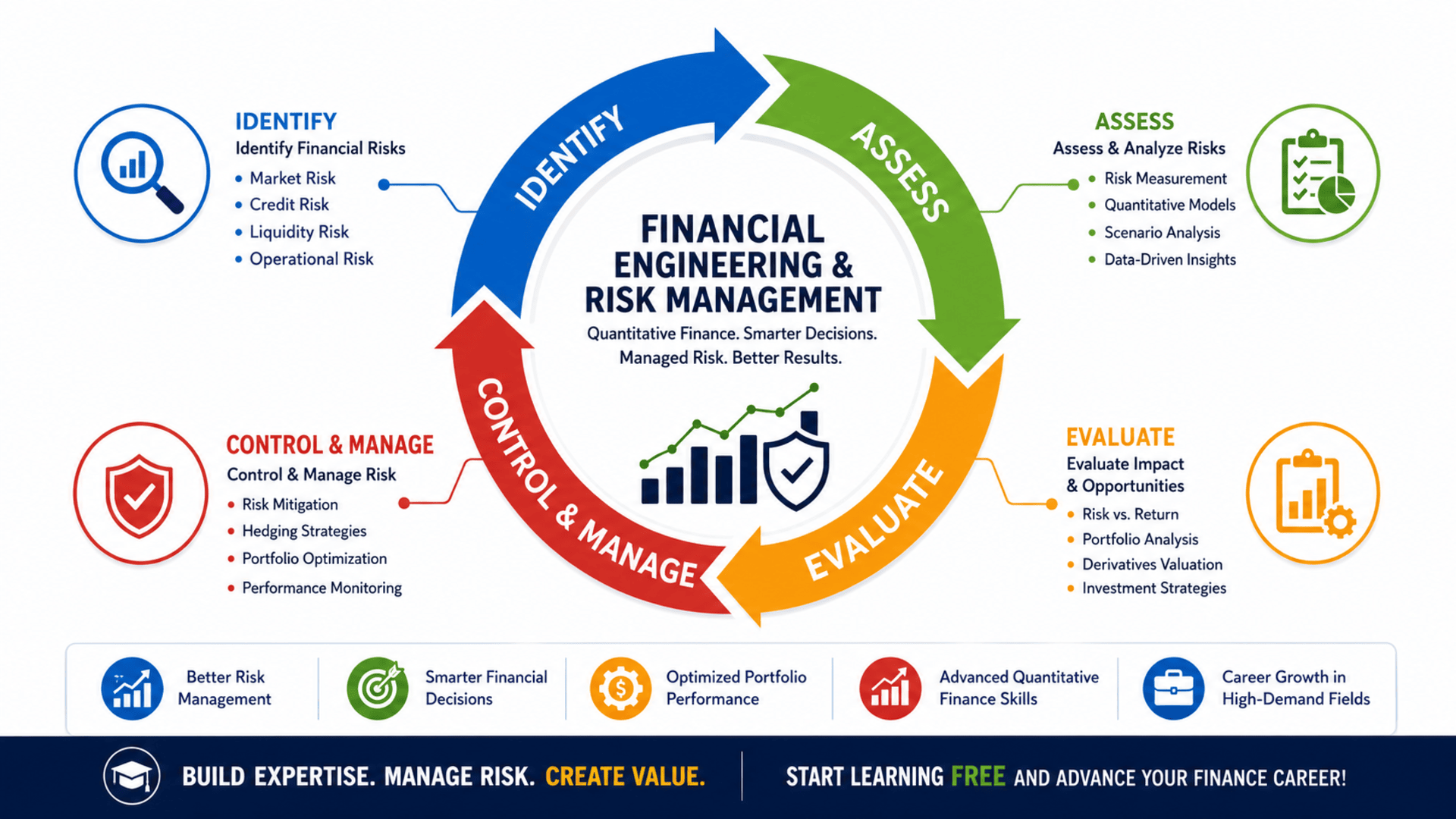
Modern financial markets are driven by data, mathematical models, risk analysis, and advanced financial decision-making. Financial institutions, investment firms, banks, hedge funds, and asset managers increasingly rely on quantitative techniques to evaluate opportunities, manage risk, and optimize investment performance.
This growing demand has made Financial Engineering and Risk Management one of the most valuable disciplines in modern finance.
If you want to understand how financial professionals analyze risk, value complex financial instruments, build quantitative models, and support investment decisions, this specialization offers an outstanding learning opportunity.
Best of all, you can Start Learning Free today and begin building advanced finance skills used by professionals across global financial markets.
Why Financial Engineering and Risk Management Matter
Financial markets involve uncertainty, volatility, and risk.
Organizations need professionals who can evaluate financial risks, develop mathematical models, and support investment decisions using data-driven approaches.
Financial engineering and risk management help organizations:
✔️ Evaluate Market Risk
✔️ Analyze Investment Opportunities
✔️ Price Financial Instruments
✔️ Manage Portfolio Risk
✔️ Improve Financial Decision-Making
✔️ Support Asset Management
✔️ Enhance Investment Strategies
✔️ Reduce Financial Exposure
These capabilities are critical in today’s increasingly complex financial environment.
What Is Financial Engineering?
Financial engineering combines finance, mathematics, statistics, economics, and computational methods to solve complex financial problems.
The discipline focuses on:
✔️ Quantitative Finance
✔️ Risk Management
✔️ Derivatives Pricing
✔️ Financial Modeling
✔️ Portfolio Optimization
✔️ Asset Valuation
✔️ Market Analysis
✔️ Financial Innovation
✔️ Investment Analytics
✔️ Risk Measurement
Financial engineers use analytical tools to evaluate financial markets and support strategic decisions.
What You Will Learn
This specialization introduces learners to advanced concepts used in quantitative finance and risk management.
Topics include:
✔️ Financial Engineering Fundamentals
✔️ Risk Management Principles
✔️ Quantitative Finance
✔️ Derivatives Markets
✔️ Options Pricing
✔️ Futures Contracts
✔️ Financial Modeling
✔️ Portfolio Theory
✔️ Market Risk Analysis
✔️ Asset Pricing
✔️ Investment Strategies
✔️ Financial Decision-Making
Learners gain a deeper understanding of how financial professionals assess risk and create value in financial markets.
Skills You Can Add to Your Resume
After completing the program, learners can demonstrate expertise in:
✔️ Financial Engineering
✔️ Risk Management
✔️ Quantitative Finance
✔️ Financial Modeling
✔️ Derivatives Analysis
✔️ Portfolio Management
✔️ Asset Pricing
✔️ Investment Analysis
✔️ Market Risk Assessment
✔️ Financial Mathematics
✔️ Data-Driven Decision-Making
✔️ Financial Analytics
These skills are highly valued in banking, investment management, consulting, and financial technology sectors.
Who Should Enroll?
This specialization is ideal for:
✔️ Finance Professionals
✔️ Investment Analysts
✔️ Risk Analysts
✔️ Financial Analysts
✔️ Portfolio Managers
✔️ Quantitative Analysts
✔️ Banking Professionals
✔️ FinTech Professionals
✔️ Students Interested in Quantitative Finance
✔️ Professionals Seeking Career Advancement
The program provides valuable knowledge for both aspiring and experienced finance professionals.
Why This Program Stands Out
Unlike many introductory finance programs, this specialization focuses on advanced analytical methods used in professional financial environments.
Benefits include:
✔️ Strong Quantitative Focus
✔️ Real-World Financial Applications
✔️ Industry-Relevant Concepts
✔️ Advanced Risk Analysis Techniques
✔️ Flexible Online Learning
✔️ Career-Oriented Curriculum
✔️ Practical Financial Modeling Knowledge
The curriculum helps learners understand how quantitative tools support modern financial markets.
Career Opportunities After Completion
Financial engineering and risk management skills open doors to a wide range of career opportunities, including:
✔️ Financial Analyst
✔️ Quantitative Analyst
✔️ Risk Analyst
✔️ Investment Analyst
✔️ Portfolio Analyst
✔️ Financial Engineer
✔️ Asset Management Specialist
✔️ Treasury Analyst
✔️ Banking Professional
✔️ Financial Consultant
These roles are increasingly important as organizations seek professionals capable of analyzing complex financial data and managing risk effectively.
Start Learning Free Today
One of the biggest advantages of this specialization is the ability to start learning free before purchasing full access.
This allows learners to evaluate the content and determine whether it aligns with their professional goals.
How to Start Learning Free
- Open the course page.
- If the page is a Professional Certificate or Specialization, scroll down and select one of the individual courses inside the program.
- Open the course you selected.
- Click Enroll.
- After signing in, choose Preview instead of Start Free Trial.
- You can now watch the course videos and start learning for free.
This option allows learners to begin building valuable quantitative finance and risk management skills immediately.
Why Quantitative Finance Skills Are in Demand
Financial institutions increasingly depend on professionals who can analyze data, model risk, and support investment decisions.
Organizations seek individuals who can:
✔️ Evaluate Market Conditions
✔️ Measure Financial Risk
✔️ Analyze Investment Performance
✔️ Build Quantitative Models
✔️ Support Portfolio Management
✔️ Improve Financial Forecasting
✔️ Develop Data-Driven Strategies
✔️ Navigate Complex Financial Markets
These capabilities make financial engineering and risk management professionals highly valuable contributors to organizational success.
📈 Start Learning Free Today
Master financial engineering, quantitative finance, derivatives, portfolio management, financial modeling, and risk analysis skills used by leading financial institutions.
Build advanced finance and risk management expertise.
Start Learning FreeExplore the course content, strengthen your quantitative finance capabilities, and learn how professionals manage risk and optimize investment decisions.