
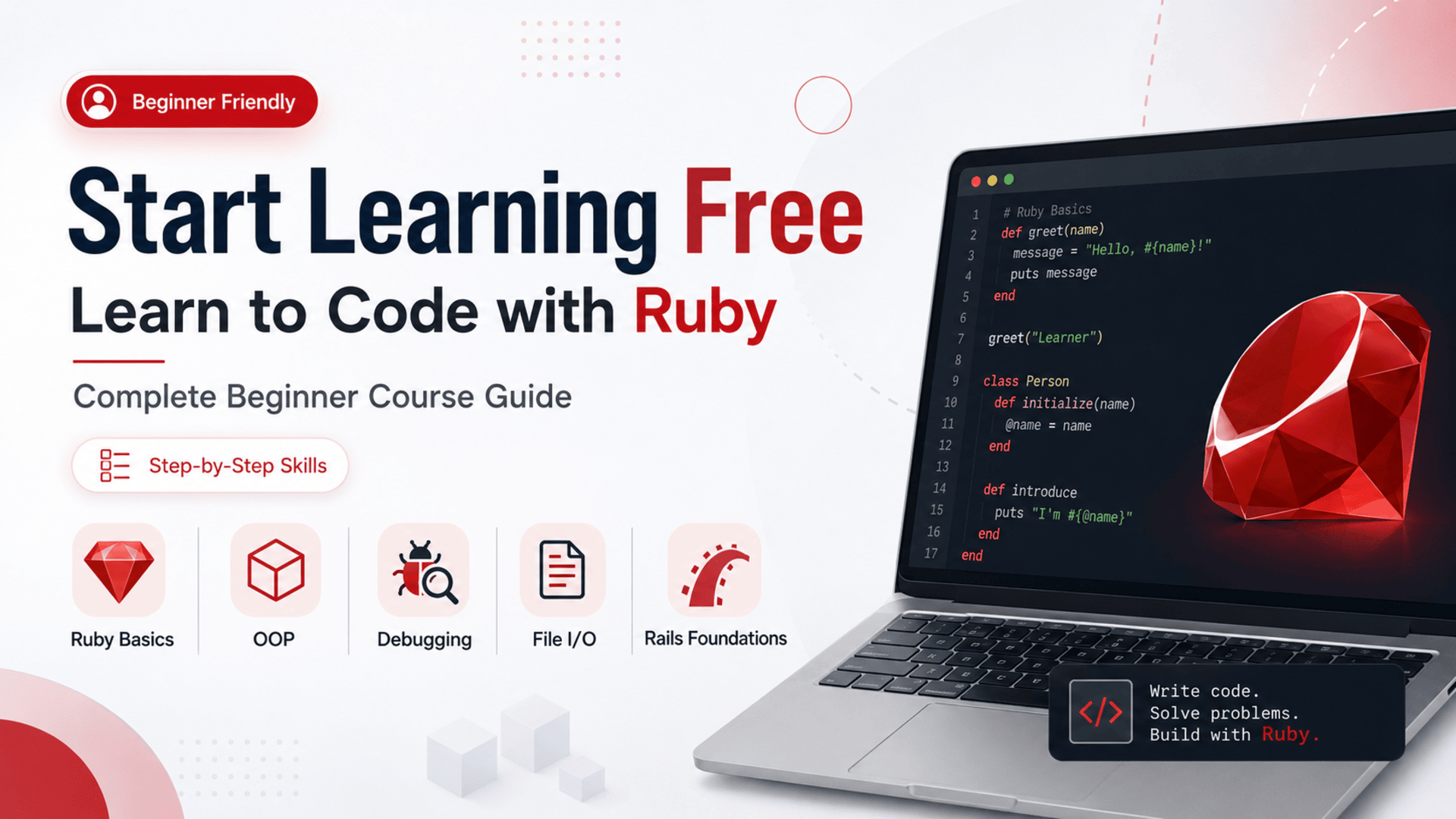
Ruby is one of the most beginner-friendly programming languages for learners who want to understand coding, web development, object-oriented programming, automation, and software design.
The Learn to Code with Ruby Complete Beginner Course Guide is designed for learners who want to build practical Ruby programming skills step by step, starting with setup and basic syntax before moving into control structures, debugging, classes, modules, inheritance, blocks, procs, lambdas, File I/O, and real-world coding practice.
You can start learning free by opening one of the individual courses and checking whether preview lessons are available before choosing complete enrollment.
What Will You Learn?
This course guide helps learners build practical Ruby skills in:
- Ruby programming fundamentals
- Ruby installation and setup
- Development environment configuration
- Variables and data types
- Strings, numbers, and Booleans
- Arithmetic operations
- Input and output
- Conditional logic
- Loops and control structures
- Arrays and hashes
- Ranges and collections
- Debugging Ruby programs
- Blocks, procs, and lambdas
- Classes and modules
- Object-oriented programming
- Inheritance and the super keyword
- File input and output
- Date and time manipulation
- Code reusability
- Ruby on Rails foundations
- Practical command-line tools and applications
These skills can help learners build confidence with coding and prepare for future paths in web development, software engineering, scripting, and backend development.
Courses Included in the Program
1. Ruby Fundamentals and Basic Programming Concepts
Start with the foundations of Ruby programming.
This course introduces Ruby installation, environment setup, basic syntax, variables, data types, programming principles, debugging, object-oriented programming basics, and command-line development.
It is a strong starting point for learners who want to understand how Ruby code is written, executed, tested, and improved.
2. Intermediate Ruby Programming and Control Structures
Build stronger Ruby logic and problem-solving skills.
This course covers Ruby strings, single and double quotes, loops, control structures, arrays, ranges, debugging tools, data structures, and practical methods for writing cleaner Ruby programs.
These topics help learners understand how Ruby handles decisions, repetition, collections, and common programming workflows.
3. Advanced Ruby Programming and Object-Oriented Design
Go deeper into professional Ruby concepts.
This course introduces blocks, procs, lambdas, complex class hierarchies, modules, inheritance, the super keyword, File I/O, sets, date and time operations, application design, technical documentation, test cases, and reusable code structures.
This section is especially useful for learners who want to write more flexible and maintainable Ruby applications.
Practical Projects You Can Build
During this learning path, learners can practise through projects such as:
- Simple command-line tools
- Interactive Ruby applications
- Data manipulation programs
- Object-oriented Ruby programs
- File handling utilities
- Reusable class-based applications
- Basic web development foundations
- Ruby on Rails preparation projects
These projects help learners apply Ruby concepts in practical coding scenarios instead of only learning theory.
Who Should Take This Course?
This course guide is suitable for:
- Programming beginners
- Ruby beginners
- Web development learners
- Software development students
- Career changers entering technology
- Developers exploring Ruby
- Learners interested in Ruby on Rails
- Anyone who wants to build a strong coding foundation
Although the program moves into intermediate topics, it starts with important foundations that can help motivated beginners build confidence step by step.
Why Ruby Skills Matter
Ruby is known for clean syntax, readability, and developer-friendly design.
It is often used in web development, scripting, backend development, automation, software tools, and Ruby on Rails applications. Learning Ruby can help beginners understand important programming ideas such as variables, control flow, objects, classes, modules, inheritance, debugging, and reusable code.
Ruby is also a strong language for learners who want to understand object-oriented programming in a clear and practical way.
How to Start Learning Free
Follow these steps to check for available preview lessons:
- Open the course guide link below.
- Scroll down and select one of the individual courses inside the program.
- Open the course you selected.
- Click Enroll.
- After signing in, choose Preview instead of Start Free Trial.
- You can now watch the available preview videos and start learning for free.
Preview availability may vary. Complete lessons, assignments, projects, certificates, and full program access may require paid enrollment. If preview access is unavailable, check whether financial aid is offered.
Build Practical Ruby Programming Skills
Learning Ruby is not only about writing code. It is about understanding how programs are structured, how data is handled, how errors are fixed, how reusable code is designed, and how object-oriented applications are built.
This program gives learners a structured path to start with Ruby basics and continue toward more advanced programming concepts, making it useful for beginners who want to grow into confident developers.
Start Learning Ruby Programming
Explore Ruby syntax, variables, strings, arrays, hashes, control structures, debugging, OOP, classes, modules, inheritance, File I/O, and Ruby on Rails foundations.
Start Learning FreePreview availability and included learning materials may vary.