
Python is one of the most popular programming languages for beginners because it is easy to read, practical to use, and powerful enough for real-world projects in automation, data analysis, artificial intelligence, web development, software engineering, and API-based applications.
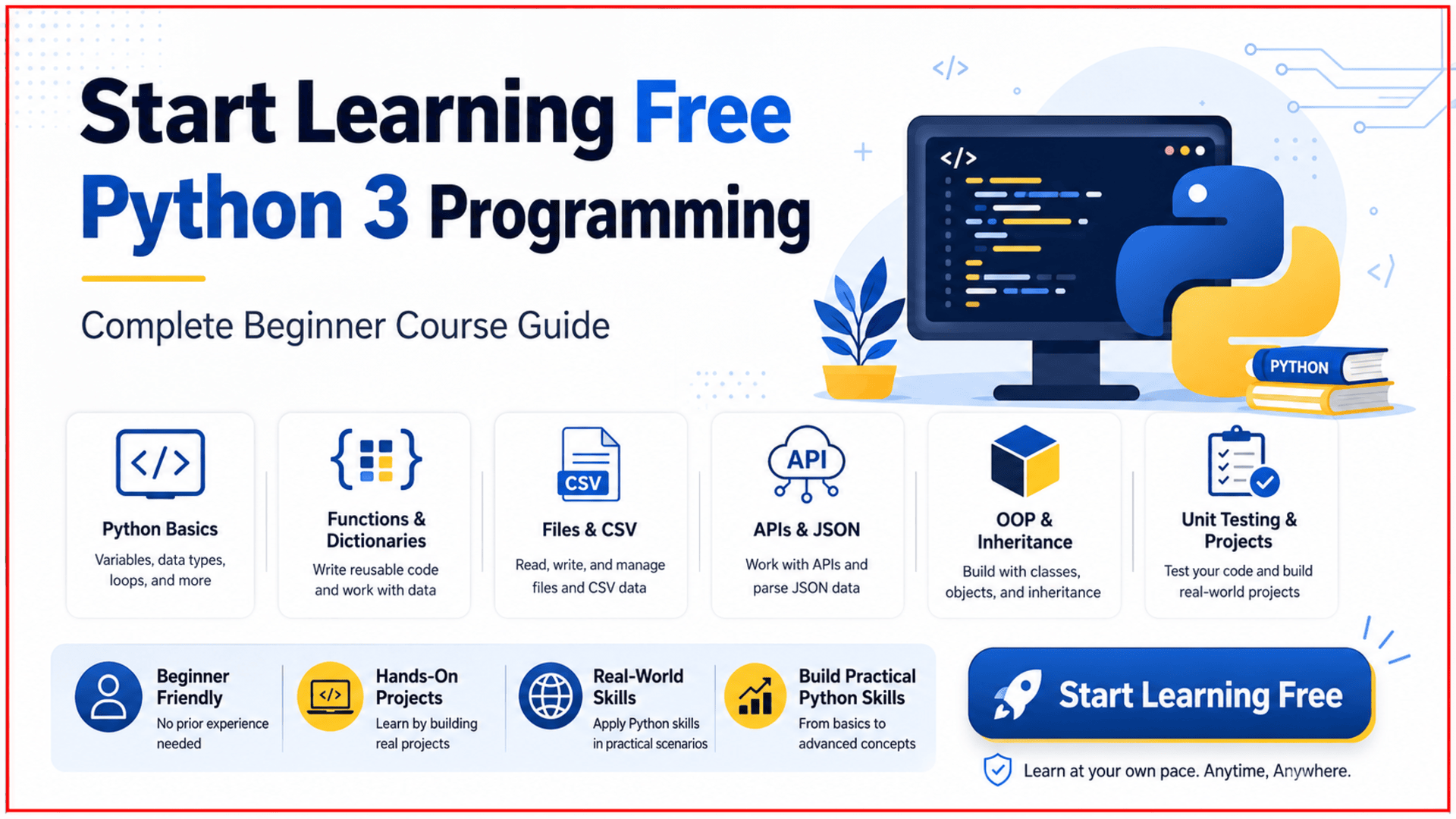
The Python 3 Programming Complete Beginner Course Guide is designed for learners who want to build a strong foundation in Python 3 through practical exercises, problem-solving, debugging, data handling, APIs, object-oriented programming, and hands-on projects.
You can start learning free by opening one of the individual courses and checking whether preview lessons are available before choosing complete enrollment.
What Will You Learn?
This learning path helps learners build practical Python 3 skills in:
- Python 3 programming fundamentals
- Variables and expressions
- Conditionals and loops
- Lists and strings
- Functions and parameters
- Dictionaries and data structures
- File input and output
- CSV file manipulation
- Data collection and processing
- REST API usage
- JSON data handling
- List comprehensions
- Lambda expressions
- Sorting and custom sorting
- Debugging and error fixing
- Classes and inheritance
- Object-oriented programming
- Unit testing
- Software documentation
- Image manipulation
- OCR and object detection concepts
- Independent programming practice
These skills can help learners move from basic Python syntax to practical programming workflows used in real technical projects.
Courses Included in the Program
1. Python Basics
Start with the foundations of Python 3 programming.
This course introduces variables, conditional statements, loops, strings, lists, basic data structures, programming logic, drawing-based exercises, and debugging practice.
It is a strong starting point for learners who want to understand how Python programs are written, executed, and improved.
2. Python Functions, Files, and Dictionaries
Build stronger Python skills by learning how to use functions, files, and dictionaries.
This course covers user-defined functions, local and global variables, parameter passing, named functions, lambda expressions, sorting, CSV manipulation, and social media data analysis projects.
These topics are important because real Python programs often need to organize reusable logic and process structured data.
3. Data Collection and Processing with Python
Learn how Python can collect and process data from online services.
This course introduces REST APIs, API documentation, the requests module, JSON, list comprehensions, data extraction, data transformation, and API-based data processing.
These skills are especially useful for learners interested in automation, data analysis, web data, and application integration.
4. Python Classes and Inheritance
Go deeper into object-oriented programming with Python.
This course covers classes, instances, inheritance, class design, reusable functionality, overriding built-in methods, writing automated tests, and creating more organized Python programs.
This section helps learners move beyond simple scripts and start thinking like software developers.
5. Python Project: Software Engineering and Image Manipulation
Apply your Python 3 skills in a final project.
This course focuses on reading documentation, working with third-party libraries, using image processing tools, manipulating images, applying OCR concepts, detecting text in images, and building a larger practical Python project.
It helps learners connect programming fundamentals with real-world software engineering practice.
Practical Projects You Can Build
During this learning path, learners can practise through projects such as:
- Basic Python programs
- Debugging exercises
- Drawing-based coding tasks
- CSV data analysis projects
- Social media sentiment analysis
- API-based data collection tools
- Movie recommendation projects
- Object-oriented Python programs
- Automated unit-tested code
- Image manipulation projects
- OCR-based text detection workflows
These projects help learners apply Python in practical situations instead of only memorizing syntax.
Who Should Take This Course?
This course guide is suitable for:
- Python beginners
- Programming beginners
- Computer science learners
- Data analysis beginners
- AI and machine learning beginners
- Automation learners
- Software development students
- Career changers entering technology
- Professionals who want practical coding skills
- Anyone who wants to become more confident with Python 3
No prior experience is required for beginners, but learners with some basic programming knowledge may progress faster.
Why Python 3 Programming Skills Matter
Python is widely used in data science, automation, artificial intelligence, machine learning, scripting, backend development, web APIs, education, business workflows, and software engineering.
Learning Python 3 can help beginners understand core programming concepts such as logic, data structures, functions, files, objects, APIs, testing, and debugging.
It is also a strong foundation for advanced paths such as data science, AI, machine learning, backend development, automation, and software engineering.
How to Start Learning Free
Follow these steps to check for available preview lessons:
- Open the course guide link below.
- Scroll down and select one of the individual courses inside the program.
- Open the course you selected.
- Click Enroll.
- After signing in, choose Preview instead of Start Free Trial.
- You can now watch the available preview lessons and start learning for free.
Preview availability may vary. Complete lessons, assignments, projects, certificates, and full program access may require paid enrollment. If preview access is unavailable, check whether financial aid is offered.
Build Practical Python 3 Programming Skills
Learning Python 3 is not only about writing code. It is about solving problems, understanding data, debugging errors, reading documentation, using APIs, creating reusable functions, building object-oriented programs, and completing practical projects.
This course guide gives learners a structured path to start with Python basics and continue toward functions, files, dictionaries, APIs, JSON, classes, inheritance, unit testing, image manipulation, OCR concepts, and real-world Python project development.
Start Learning Python 3 Programming
Explore Python 3 basics, variables, loops, lists, functions, dictionaries, files, APIs, JSON, OOP, inheritance, unit testing, image manipulation, and hands-on Python projects.
Start Learning FreePreview availability and included learning materials may vary.