
Rust is one of the most valuable programming languages for developers who want to build fast, safe, reliable, and high-performance software.
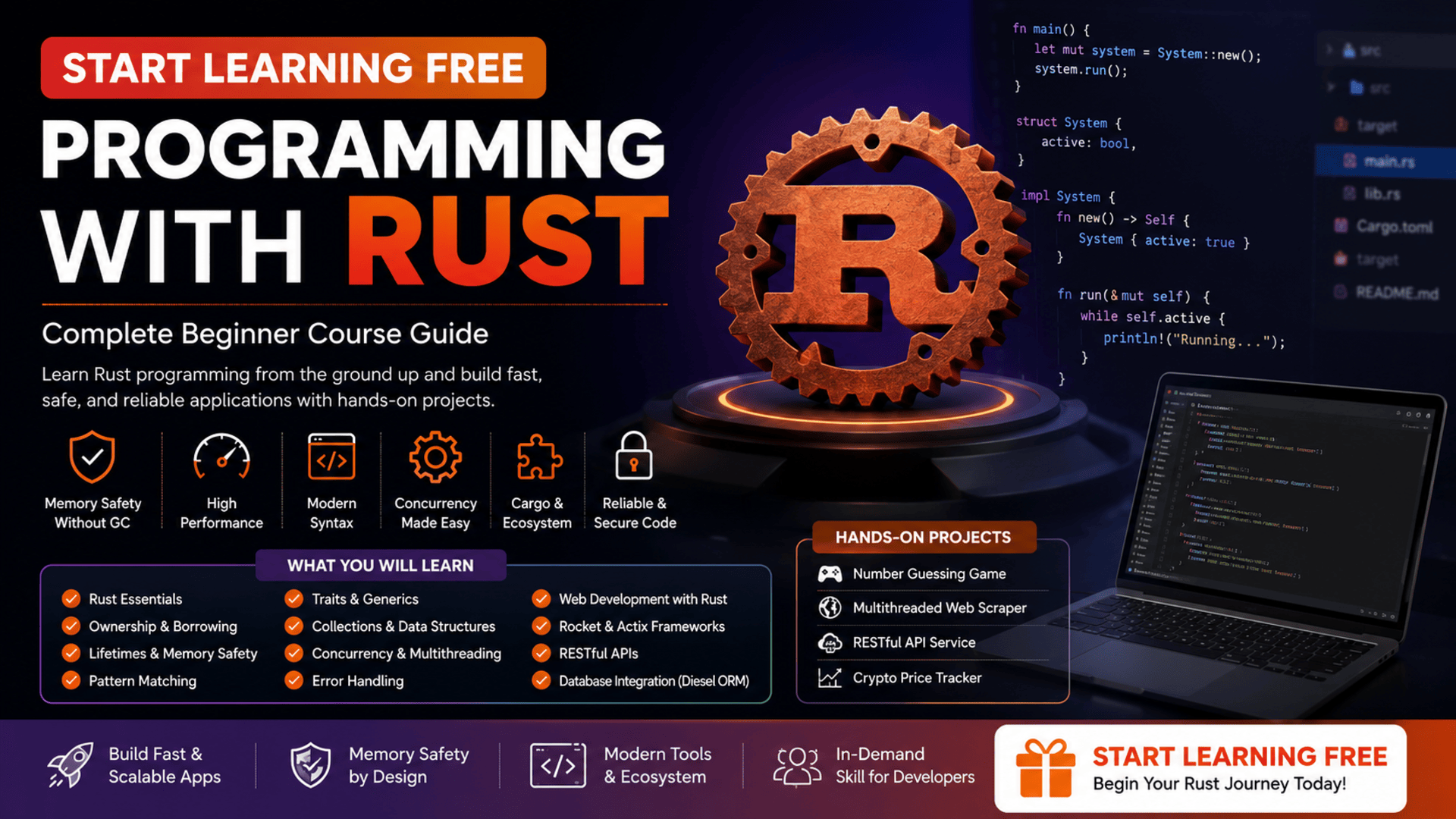
The Programming with Rust Complete Beginner Course Guide is designed for learners who want to understand Rust programming, memory safety, ownership, borrowing, lifetimes, pattern matching, traits, generics, concurrency, web development, RESTful APIs, and scalable backend services.
You can start learning free by opening one of the individual courses and checking whether preview lessons are available before choosing complete enrollment.
What Will You Learn?
This learning path helps learners build practical Rust programming skills in:
- Rust programming fundamentals
- Ownership and borrowing
- Lifetimes and memory safety
- Pattern matching
- Control flow
- Rust type system
- Generics and traits
- Cargo build tools
- Dependency management
- Error handling
- Data structures
- Collections, vectors, arrays, and slices
- Advanced memory management
- Concurrency and multithreading
- High-performance application development
- Web development with Rust
- Rocket and Actix frameworks
- RESTful API design
- Database integration
- Diesel ORM
- HTTP request handling
- Scalable backend services
These skills can help learners understand how Rust is used for systems programming, backend development, web services, performance-focused applications, and secure software development.
Courses Included in the Program
1. Rust Programming Essentials
Start with the foundations of Rust programming.
This course introduces Rust’s core principles, including memory safety, ownership, borrowing, pattern matching, control flow, type systems, generics, traits, and Cargo for building scalable Rust projects.
It is a strong starting point for learners who want to understand why Rust is different from many other programming languages.
2. Advanced Rust Programming
Build stronger Rust skills by learning advanced concepts used in high-performance applications.
This course covers concurrency, multithreading, advanced memory management, lifetimes, borrowing rules, collections, vectors, arrays, slices, traits, generics, reusable code, and performance-focused application design.
These topics are important for learners who want to write faster, safer, and more efficient applications.
3. Web Development with Rust
Learn how Rust can be used to build modern backend and web services.
This course covers routing, HTTP request handling, RESTful API development, Rocket, Actix, database connections, CRUD operations, Diesel ORM, backend application design, server-side development, and scalable web services.
It is useful for developers who want to explore Rust beyond systems programming and apply it to real backend projects.
Hands-On Projects You Can Build
During this learning path, learners can practise through projects such as:
- A number-guessing game
- Rust command-line applications
- Memory-safe programs
- Multithreaded applications
- A multithreaded web scraper
- RESTful API services
- Database-backed web applications
- A crypto price tracker
- Scalable backend services
- Rust projects managed with Cargo
These practical projects help learners move from theory to real application development.
Who Should Take This Course?
This guide is suitable for:
- Developers who want to learn Rust
- Software engineers
- Backend developers
- Systems programming learners
- Web developers exploring Rust
- IT professionals improving technical skills
- Programmers moving from Python, Java, C++, or Go
- Learners interested in memory-safe programming
- Developers interested in concurrency and performance
- Anyone who wants to build scalable and secure applications
Some previous programming knowledge is recommended because Rust introduces concepts such as ownership, borrowing, and lifetimes that may be challenging for complete beginners.
Why Rust Skills Matter
Rust is known for combining performance with memory safety.
It helps developers build reliable software without many of the memory-related problems that can happen in lower-level programming. Rust is also becoming more popular in systems programming, backend services, cloud infrastructure, command-line tools, blockchain development, data engineering, and high-performance web applications.
Learning Rust can help developers understand safer memory management, better concurrency, cleaner system design, and efficient application development.
How to Start Learning Free
Follow these steps to check for available preview lessons:
- Open the course guide link below.
- Scroll down and select one of the individual courses inside the program.
- Open the course you selected.
- Click Enroll.
- After signing in, choose Preview instead of Start Free Trial.
- You can now watch the available preview lessons and start learning for free.
Preview availability may vary. Complete lessons, projects, assessments, certificates, and full program access may require paid enrollment. If preview access is unavailable, check whether financial aid is offered.
Build Practical Rust Programming Skills
Learning Rust is not only about syntax. It is about understanding how to write safe, fast, reusable, and scalable software.
This course guide gives learners a structured path to start with Rust essentials and continue toward ownership, borrowing, lifetimes, generics, traits, concurrency, web development, RESTful APIs, database integration, and real-world Rust projects.
Start Learning Programming with Rust
Explore Rust fundamentals, ownership, borrowing, lifetimes, memory safety, traits, generics, concurrency, Rocket, Actix, REST APIs, database integration, and backend development.
Start Learning FreePreview availability and included learning materials may vary.