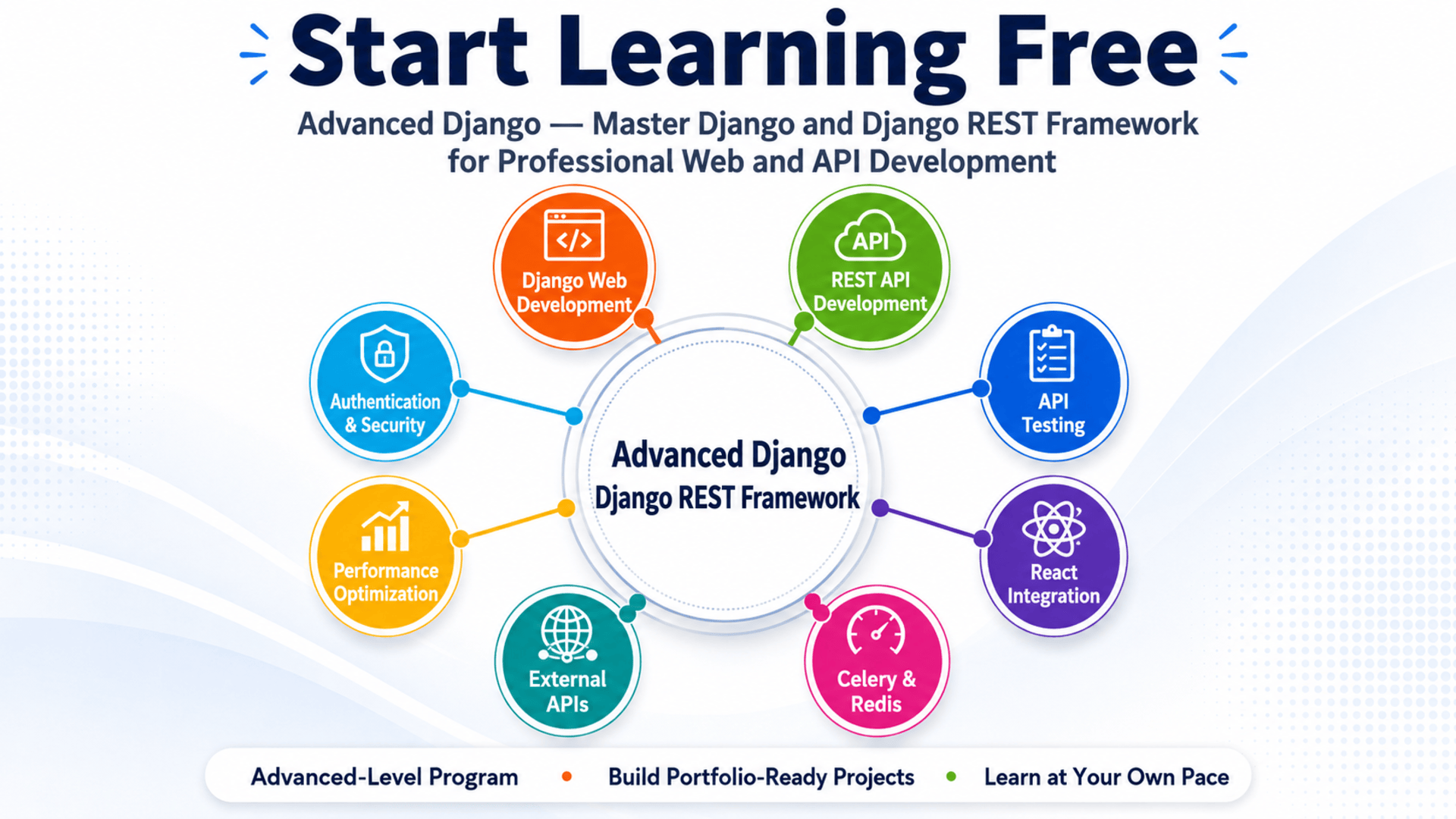
Start Learning Free: Advanced Django — Master Django and Django REST Framework for Professional Web and API Development

Django is one of the most powerful frameworks for building secure, scalable, and maintainable web applications with Python.
Learning the fundamentals can help you create simple websites. However, professional backend development requires deeper knowledge of application architecture, database optimization, authentication, API development, testing, caching, frontend integration, asynchronous processing, and external services.
The Advanced Django: Mastering Django and Django REST Framework program is designed for developers who want to move beyond basic Django projects and develop more sophisticated web applications and APIs.
Through four connected courses, learners build and improve a Django blog, create a RESTful API, test and optimize that API, connect it with React, work with external APIs, and schedule background tasks with Celery and Redis.
You may also be able to Start Learning Free by previewing selected content from one of the individual courses before choosing a complete enrollment option.
Why Advanced Django Skills Matter
Basic Django knowledge can help developers create models, views, templates, forms, and simple database-driven applications.
Real-world development often requires much more.
Professional Django developers may need to:
- Design applications that remain maintainable as they grow
- Improve database performance
- Cache frequently requested content
- Implement secure user authentication
- Create APIs for web and mobile applications
- Validate incoming data
- Manage permissions and authorization
- Test API endpoints
- Connect backend services to JavaScript frameworks
- Consume external APIs
- Run long or recurring tasks in the background
- Prepare applications for larger numbers of users
This advanced learning program brings these capabilities together through a practical, project-based learning path.
About the Advanced Django Program
Advanced Django: Mastering Django and Django REST Framework is a four-course, advanced-level program developed for learners who already have experience with Python and the foundations of Django.
The program takes approximately four weeks when studying for about ten hours per week. It contains roughly 40 hours of learning material and offers a flexible schedule, allowing learners to progress at their own pace.
The four courses are designed to be completed in order because each course continues working with the same application and codebase developed during the previous stage.
Throughout the program, learners create an increasingly sophisticated blog application and the API that supports it.
Who Is This Program Designed For?
This Advanced Django program may be suitable for:
Python Developers
Developers who understand Python and want to specialize in backend or full-stack web development.
Django Developers
Learners who can already create basic Django applications but want to study more advanced architecture, performance, security, APIs, and integrations.
Backend Developers
Professionals who want to develop secure and scalable REST APIs using Python and Django REST Framework.
Full-Stack Developers
Developers who want to connect Django backend services with React or other JavaScript frameworks.
Software Engineering Students
Students who want to strengthen their practical development portfolio with a complete web application and RESTful API.
Freelance Developers
Freelancers who want to offer more advanced web development, API development, application integration, and backend optimization services.
Developers Preparing for Technical Roles
Professionals who want practical experience with Django, REST APIs, testing, Postman, Celery, Redis, React integration, and external services.
Recommended Knowledge Before Starting
This is not an introductory Python or Django program.
Learners should already be familiar with:
- Python programming fundamentals
- Django models
- Django views
- Templates and forms
- URL routing
- Database migrations
- Basic authentication
- Object-relational mapping
- Basic HTML and web concepts
Previous completion of a foundational Django learning path—or equivalent practical experience—is recommended.
Learners who have never used Python or Django may benefit from studying the fundamentals before beginning this advanced program.
What Will You Learn?
The Advanced Django program develops practical knowledge across professional web development and API engineering.
Important learning outcomes include:
- Creating an advanced blog with Django
- Developing custom templates and template filters
- Optimizing database queries and operations
- Improving application performance with caching
- Authenticating users through Google
- Creating a RESTful API with Django REST Framework
- Testing APIs with Postman
- Working with serializers, routers, and viewsets
- Implementing authentication and permissions
- Validating API data
- Optimizing Django REST Framework applications
- Writing automated API tests
- Connecting a Django API to React
- Consuming external APIs
- Scheduling asynchronous tasks with Celery
- Using Redis as part of a task-queuing system
- Combining backend, API, testing, and integration skills in a final project
Advanced Django Course Breakdown
The program contains four connected courses. Each course builds on the application created in the previous course.
Course 1: Advanced Django — Building a Blog
Estimated learning time: 10 hours
The first course focuses on developing and optimizing a blog application with Django.
Learners move beyond basic views and templates by exploring more advanced application-development techniques.
Topics include:
- Creating custom filters
- Building custom templates
- Improving the user experience
- Optimizing database operations
- Using caching to improve performance
- Managing user accounts
- Authenticating users with Google
- Strengthening application security
- Working with Django’s object-relational mapping system
Performance optimization is an important part of professional Django development. Poorly designed queries and repeated database operations can slow an application as its traffic and data increase.
This course introduces methods for building a more efficient and maintainable Django application.
Course 2: Introduction to Django REST Framework
Estimated learning time: 9 hours
The second course introduces API development with Django REST Framework.
An API allows different applications and services to communicate. For example, a Django API could supply data to a React website, mobile application, analytics tool, or external software system.
Learners build an API for the blog created in the first course.
Important topics include:
- RESTful API principles
- Django REST Framework
- JSON data
- Serializers
- Viewsets
- Routers
- Data validation
- Authentication
- Authorization
- Permissions
- Object-relational mapping
- API design
- API testing with Postman
Learners also use Postman to explore endpoints, send requests, examine responses, and understand how the API behaves.
By the end of the course, learners should understand how to expose Django application data through a structured RESTful API.
Course 3: Advanced Django REST Framework
Estimated learning time: 9 hours
The third course develops more advanced API engineering skills.
Creating a working API is only the beginning. Professional APIs must also be secure, reliable, testable, maintainable, and capable of supporting frontend applications.
Topics include:
- Optimizing Django REST Framework
- Improving API performance
- Writing tests for API endpoints
- Unit testing
- Software testing
- API authentication
- Secure coding
- Scalability
- Frontend integration
- Connecting Django with React
- Working with JavaScript frameworks
Automated testing helps developers identify problems before they reach users. It also makes future changes safer because developers can check whether existing functionality still works correctly.
React integration gives learners experience connecting a Python backend with a modern JavaScript frontend.
This combination is particularly useful for developers who want to build interactive full-stack web applications.
Course 4: External APIs and Task Queuing
Estimated learning time: 9 hours
The final course introduces external service integration and asynchronous task processing.
Modern applications frequently depend on external APIs for payments, communication, maps, authentication, analytics, social features, and other services.
Learners study how to use external APIs within a Django application and how to manage tasks that should not block the main web request.
Topics include:
- Consuming external APIs
- Event-driven programming
- Background task processing
- Task queuing
- Scheduling tasks with Celery
- Using Redis
- GitHub workflows
- Program development
- Combining all four courses into a final project
Celery allows developers to move time-consuming operations away from the immediate request-response cycle.
Examples of background tasks may include:
- Sending emails
- Generating reports
- Processing uploaded files
- Importing external data
- Running scheduled updates
- Performing recurring maintenance
- Communicating with third-party services
Redis can support this architecture by acting as a message broker or data store within the task-queuing system.
Build a Portfolio-Ready Django Project
The practical project is one of the most valuable parts of this advanced learning path.
Learners begin by creating and optimizing a Django blog application. They then build a RESTful API for the blog using Django REST Framework.
As the program progresses, learners enhance the project with:
- Custom templates and filters
- Database optimization
- Caching
- User authentication
- API serializers
- Viewsets and routers
- Permissions
- Data validation
- Automated testing
- React integration
- External APIs
- Celery task scheduling
- Redis
- Performance improvements
The final capstone brings these skills together in a portfolio-ready project.
A completed project can help demonstrate that the learner understands how different elements of modern Django development work together—not only how to complete isolated coding exercises.
Django and Django REST Framework Skills You Can Develop
The program covers a broad collection of backend, API, security, performance, and integration skills.
Django Development
Learn how to structure and improve a Django web application using custom functionality, authentication, templates, database operations, and advanced modules.
REST API Development
Create RESTful services that allow web applications, mobile applications, and other systems to interact with Django data.
API Design
Organize endpoints and resources in ways that make an API easier to understand, maintain, and use.
Authentication and Authorization
Control who can access an application and what authenticated users are allowed to do.
Data Validation
Check incoming API data before it is processed or stored.
API Testing
Use Postman and automated tests to confirm that endpoints behave as expected.
Performance Optimization
Improve application speed through caching, database optimization, and more efficient API behavior.
Secure Coding
Apply security principles when handling users, permissions, data, and application requests.
React Integration
Connect Django backend services with a modern JavaScript user interface.
Asynchronous Task Processing
Use Celery and Redis to manage long-running, scheduled, or background processes.
Tools and Technologies Covered
Learners gain experience with several tools and technologies commonly used in modern web development:
- Python
- Django
- Django REST Framework
- JSON
- RESTful APIs
- Postman
- React
- JavaScript
- Celery
- Redis
- GitHub
- Object-relational mapping
- API testing tools
- Frontend integration tools
Understanding how these technologies work together can help developers build more complete web solutions.
Why Learn Django REST Framework?
Many modern applications separate the frontend interface from the backend system.
The frontend may be created with React, another JavaScript framework, a mobile application, or a third-party client. The Django backend manages business logic, user accounts, permissions, and data.
Django REST Framework helps developers expose backend functionality through APIs.
Learning Django REST Framework can help developers:
- Build APIs more efficiently
- Convert model data into JSON
- Validate incoming requests
- Manage authentication
- Apply user permissions
- Organize endpoints
- Test API behavior
- Support web and mobile frontends
- Integrate with external systems
- Create reusable backend services
These capabilities are increasingly important in backend and full-stack development.
Why Learn Celery and Redis with Django?
Some application tasks take too long to complete during a normal web request.
Forcing the user to wait while these operations finish can create a slow and frustrating experience.
Celery enables Django developers to send these operations to background workers. Redis can help manage communication between the application and those workers.
Learning these tools can prepare developers to build applications that handle:
- Background emails
- Scheduled jobs
- External data processing
- Notifications
- Large calculations
- File processing
- Automated reports
- Recurring tasks
This knowledge is useful for developers working on applications with more complex performance and automation requirements.
How to Start Learning Free
You may be able to Start Learning Free by opening one of the individual courses and checking whether a Preview option is available.
Follow these steps:
- Open the course link.
- Because this is a Specialization, scroll down until you find the four individual courses.
- Select one of the courses inside the program.
- Open the individual course page.
- Click Enroll.
- Sign in or create an account when requested.
- Check whether Preview appears as an alternative to starting a free trial or selecting a paid enrollment option.
- When Preview is available, open the accessible videos or learning materials and begin studying.
Preview availability can vary according to the course, account, location, and current enrollment options.
A Preview may provide selected videos or materials, but it does not normally include the full specialization, all assessments, hands-on assignments, or the career certificate.
Is the Complete Advanced Django Program Free?
The complete four-course program is not presented as a fully free specialization.
“Start Learning Free” refers only to selected Preview materials when that option is available.
Complete access, graded assignments, the capstone project, and the shareable certificate may require a subscription or another eligible enrollment option.
Learners who cannot afford the enrollment cost should also check whether financial aid is available for their selected course.
How Long Does the Program Take?
The complete program takes approximately 40 hours.
Learners who study for around ten hours each week may finish it in approximately four weeks.
Because the schedule is flexible, completion time depends on:
- Previous Django experience
- Weekly study time
- Project complexity
- Time spent practicing
- Time required to debug code
- Whether the learner completes optional exercises
Developers who create additional features for their final project may take longer, but this extra practice can strengthen the resulting portfolio.
Should the Courses Be Completed in Order?
Yes.
The four courses use a connected codebase, and each stage builds on work completed in the previous course.
The recommended order is:
- Advanced Django: Building a Blog
- Introduction to Django REST Framework
- Advanced Django REST Framework
- External APIs and Task Queuing
Following this order helps learners develop the blog, API, tests, integrations, and background-task features progressively.
Can You Earn a Certificate?
A shareable career certificate is available after completing the required paid program content and assessments.
The certificate may be added to a:
- LinkedIn profile
- Resume
- CV
- Professional portfolio
- Performance review
- Personal development record
Previewing selected free materials does not provide the complete certificate.
Frequently Asked Questions
Is this Advanced Django course suitable for beginners?
It is designed for advanced learners. You should already understand Python and basic Django development before starting.
How many courses are included?
The specialization contains four connected courses covering Django application development, REST APIs, testing, React integration, external APIs, Celery, and Redis.
Can I Start Learning Free?
You may be able to preview selected materials from an individual course when a Preview option is displayed. Preview availability and accessible content can vary.
Can I complete the entire program for free?
The full specialization, graded projects, assessments, and certificate are not presented as completely free. Financial aid may be available for eligible learners.
What project will I build?
You will create and optimize a Django blog, build a RESTful API for it, test and improve the API, connect it with frontend technology, work with external APIs, and use task-queuing tools.
Will I learn Django REST Framework?
Yes. The program covers serializers, viewsets, routers, authentication, authorization, permissions, validation, API design, testing, optimization, and frontend integration.
Does the program include React?
Yes. One part of the program introduces integrating a Django REST Framework API with React.
Will I learn Celery and Redis?
Yes. The final course covers scheduling asynchronous tasks with Celery and Redis.
How long will the program take?
The full specialization takes approximately 40 hours or around four weeks when studying ten hours per week.
Is the program completely online?
Yes. The learning experience is online and offers a flexible schedule.
Take Your Django Development to the Next Level
Moving from basic Django development to professional web and API engineering requires practical experience with architecture, performance, security, testing, integrations, and asynchronous systems.
This Advanced Django learning path brings these areas together through one connected project.
You can begin by exploring available Preview materials, reviewing the course structure, and identifying the skills most relevant to your development goals.
Advanced Python Web Development
Master Advanced Django and Django REST Framework
Build an optimized Django blog, develop RESTful APIs, test endpoints, integrate React, consume external APIs, and schedule background tasks with Celery and Redis.
Start Learning FreePreview availability may vary. Free preview access may not include the complete program, graded assignments, capstone project, or certificate.