Start Learning Free: Technology Entrepreneurship for Innovation, Startup Growth, and Business Success

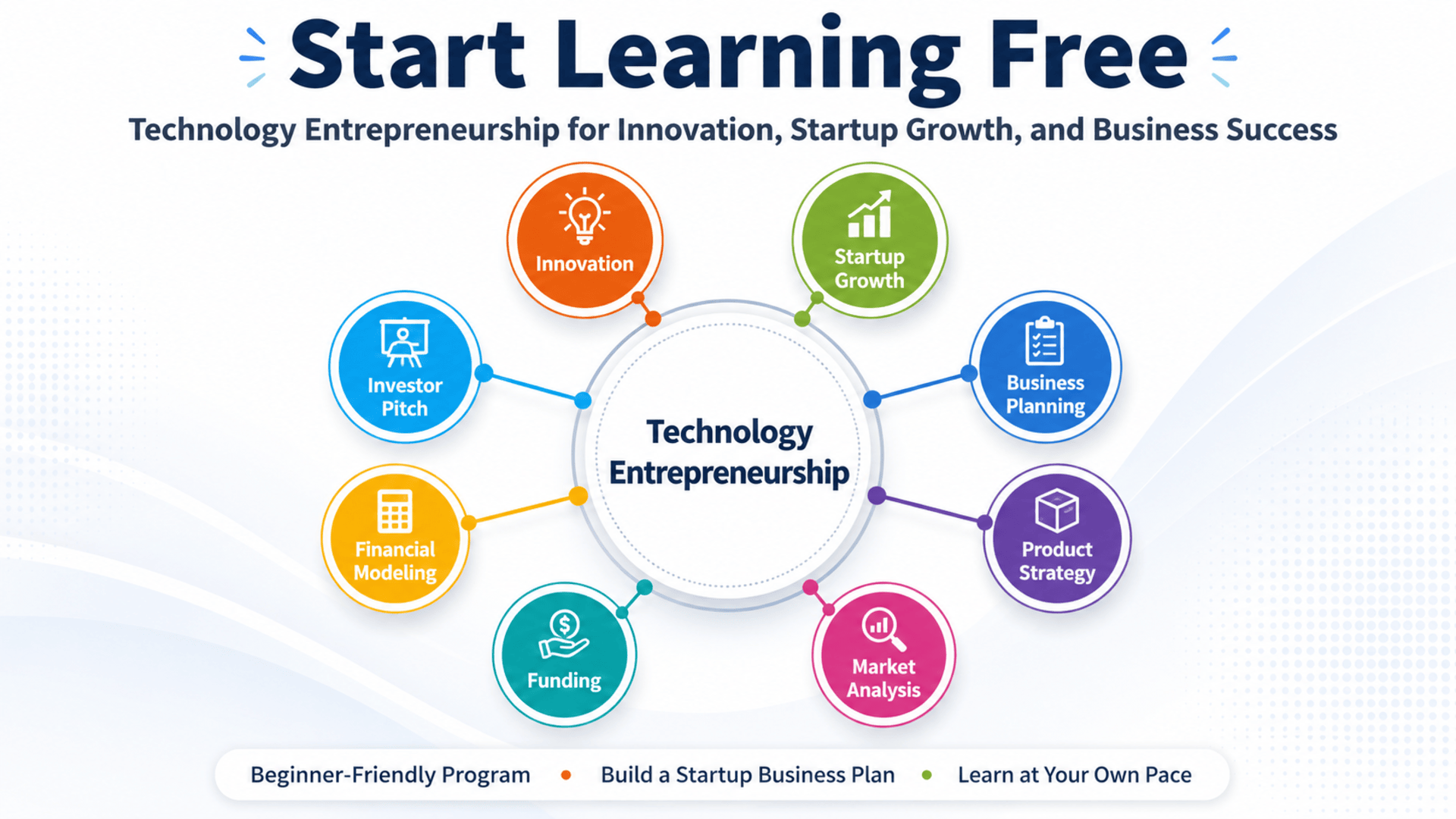
Technology is creating new business opportunities across almost every industry. However, transforming an innovative idea into a successful company requires much more than technical knowledge.
Entrepreneurs must understand their customers, validate market opportunities, develop competitive value propositions, build sustainable business models, manage operations, secure funding, and communicate their ideas clearly to investors.
The Technology Entrepreneurship program provides a structured learning path for aspiring founders, innovators, engineers, product professionals, and business leaders who want to understand how technology startups are created, funded, and launched.
You can also Start Learning Free by previewing selected content from an individual course before deciding whether full enrollment is right for you.
What Is Technology Entrepreneurship?
Technology entrepreneurship is the process of identifying an opportunity, developing a technology-driven product or service, and building a sustainable business around it.
It combines several important disciplines, including:
- Innovation and product development
- Entrepreneurship and business strategy
- Market and customer analysis
- Business modeling
- Financial planning
- Startup operations
- Funding and investor relations
- Leadership and organizational development
Successful technology entrepreneurs do not focus only on building products. They also create systems that help those products reach the right customers, generate revenue, attract investment, and grow sustainably.
This program helps learners connect technical innovation with practical business planning.
About the Technology Entrepreneurship Program
The Technology Entrepreneurship specialization is a beginner-friendly, three-course learning program developed by the University of Colorado Boulder and taught by John E. Thomas.
It is designed to help learners understand how to form, fund, and launch a new technology venture.
The complete learning path can generally be completed in approximately three to four months with around six to eight hours of study per week. The schedule is flexible, allowing learners to progress at their own pace.
No specific professional or academic background is required. An interest in technology, innovation, startups, or entrepreneurship is the most important starting point.
What Will You Learn?
By completing the program, learners can develop the knowledge required to move from an initial idea to a structured technology-startup plan.
Key learning outcomes include:
- Understanding the technology entrepreneurial mindset
- Identifying and evaluating new product opportunities
- Developing vision and mission statements
- Creating a strong value proposition
- Defining a sustainable competitive advantage
- Applying systems thinking to a startup
- Understanding founders’ and leadership responsibilities
- Building product, market, and operations plans
- Creating a startup revenue model
- Preparing financial statements and projections
- Exploring debt and equity funding options
- Understanding business structures and legal considerations
- Creating a complete technology-startup business plan
- Preparing a professional investor presentation
These skills can help learners evaluate opportunities more objectively and make better decisions before investing significant time or capital in a new venture.
Technology Entrepreneurship Course Breakdown
The program contains three connected courses. Each course builds part of the knowledge and documentation required to create a complete startup plan.
Course 1: Getting Started with Technology Startups
Estimated learning time: 40 hours
The first course introduces technology entrepreneurship and the mindset required to identify and develop new business opportunities.
Learners explore entrepreneurial motivation, orientation, support systems, opportunity recognition, and early product ideation.
The course also explains how to create essential strategic statements, including:
- Vision statements
- Mission statements
- Sustainable competitive-advantage statements
- Customer value propositions
By the end of this stage, learners should have an initial product or service idea and a clearer understanding of the opportunity it may address.
Course 2: Creating a Technology Startup Company
Estimated learning time: 35 hours
The second course focuses on turning an opportunity into a structured business.
Learners examine entrepreneurial systems thinking and explore the responsibilities of founders, management teams, and boards of directors.
The course also covers the operational elements required to manage a new technology company, including the use of performance metrics and management tools.
Learners work on three major components of their startup plan:
- Product plan
- Market plan
- Management and operations plan
This stage connects the original idea with its target market, customer personas, leadership model, operating requirements, and product strategy.
Course 3: Forming, Funding, and Launching a Technology Startup Company
Estimated learning time: 39 hours
The final course focuses on the financial, legal, and launch-related decisions involved in building a technology business.
Learners explore how to develop a revenue model and create a pro forma income statement for a new startup idea.
The course examines different startup funding sources, including debt and equity financing. It also introduces business structures, intellectual property, legal considerations, financial planning, risk analysis, and business valuation.
Learners then assemble the different sections developed throughout the program into a complete business plan and create a presentation for potential investors.
Build a Complete Technology-Startup Business Plan
One of the most valuable elements of this Technology Entrepreneurship program is its practical learning project.
Instead of studying entrepreneurship only as a theoretical subject, learners can create a complete business plan for a new technology company.
The business plan may include:
- Product or service description
- Customer and market analysis
- Target audience and customer personas
- Competitive analysis
- Value proposition
- Product-development strategy
- Market-entry plan
- Management structure
- Operations plan
- Risk analysis
- Revenue model
- Financial projections
- Funding strategy
- Executive summary
Learners can also create business presentations designed to communicate the startup opportunity to investors and other stakeholders.
This practical approach can help turn an unstructured idea into a more professional and testable business concept.
Technology Entrepreneurship Skills You Can Develop
The program covers a broad range of business, financial, strategic, and innovation skills.
Important skills include:
- Business planning
- Business modeling
- Systems thinking
- Design thinking
- Market analysis
- Persona development
- Product planning
- New product development
- Growth strategy
- Financial modeling
- Entrepreneurial finance
- Revenue modeling
- Financial-statement preparation
- Risk analysis
- Business valuation
- Intellectual-property awareness
- Operational performance management
- Leadership and management
- Investor-pitch development
These capabilities are valuable not only for founders but also for professionals working in innovation, product development, engineering management, venture building, and business transformation.
Who Should Study Technology Entrepreneurship?
This program may be suitable for:
Aspiring Technology Entrepreneurs
People who have a technology-related idea and want a structured method for evaluating and developing it.
Engineers and Technical Professionals
Professionals who understand technology but want to strengthen their business, financial, and commercial knowledge.
Product Managers
Product professionals who want to understand the wider business system surrounding product development, funding, growth, and operations.
Startup Team Members
Employees working in early-stage companies who want to understand how different startup functions work together.
Innovation Leaders
Managers responsible for identifying new opportunities, developing products, or creating new business models within established organizations.
Students and Career Changers
Beginners who want to explore entrepreneurship without needing previous startup experience.
Small-Business Owners
Business owners interested in using technology to create new products, improve operations, or develop scalable revenue models.
Why Learn Technology Entrepreneurship?
A strong idea alone does not guarantee startup success.
Entrepreneurs must be able to answer important questions:
- What problem does the product solve?
- Who is the ideal customer?
- Why should customers choose this solution?
- How large is the market opportunity?
- How will the company generate revenue?
- What resources are required?
- What are the major risks?
- How will the business attract funding?
- What makes the opportunity valuable to investors?
- How can the company grow sustainably?
Studying technology entrepreneurship provides frameworks for answering these questions before making major financial or operational commitments.
It can also help learners recognize weak assumptions, improve their business models, and communicate opportunities more professionally.
How to Start Learning Free
You may be able to Start Learning Free by previewing selected learning materials from one of the individual courses within the program.
Follow these steps:
- Open the course link.
- Because this program is a Specialization, scroll down to the section showing the individual courses.
- Select one of the courses inside the program.
- Open the individual course page.
- Click Enroll.
- Sign in or create an account when requested.
- Look for the Preview option instead of selecting Start Free Trial.
- Use the available preview materials to watch selected course videos and begin learning.
Preview availability and the amount of accessible content may differ between courses, locations, and enrollment options.
Preview access generally does not include the certificate, complete graded assessments, or all materials available through full enrollment.
Can Beginners Take This Program?
Yes. The Technology Entrepreneurship program is classified as beginner level, and no particular background is required.
You do not need to be an experienced entrepreneur, business owner, engineer, or financial specialist before starting.
The program begins with foundational entrepreneurship concepts and gradually progresses toward business planning, operations, financial modeling, funding, legal considerations, and investor pitching.
An interest in technology startups and a willingness to develop a business idea are sufficient starting points.
How Long Does the Program Take?
The three-course program contains approximately 114 hours of estimated learning content.
Learners studying for around six to eight hours per week may complete the specialization in approximately three to four months.
Because the program offers a flexible schedule, learners may progress faster or slower depending on their availability.
Will You Receive a Certificate?
A shareable career certificate is available to learners who complete the applicable full-enrollment requirements.
Previewing selected content is intended to help you explore the learning experience. Preview access alone does not provide a certificate and may not include graded assignments or the complete program.
Frequently Asked Questions
What is a technology entrepreneurship course?
A technology entrepreneurship course teaches learners how to identify technology-based opportunities, develop products, evaluate markets, create business models, explore funding, manage startup operations, and prepare for launch.
Can I Start Learning Free?
Selected individual courses may provide a Preview option that allows learners to access certain videos or learning materials without beginning a paid trial. Preview availability and included materials may vary.
Is Technology Entrepreneurship suitable for beginners?
Yes. The program is designed for beginners and does not require previous startup, business, or technology-management experience.
What practical project will I complete?
Learners have the opportunity to create a complete business plan for a technology startup, including product, market, operations, risk, financial, and funding components. They can also prepare a presentation for potential investors.
How many courses are included?
The specialization consists of three courses covering startup ideation, business creation, operations, financing, legal considerations, launch preparation, and investor pitching.
How long will it take to complete?
The recommended completion time is approximately three to four months when studying for six to eight hours each week.
What skills can I add to my career profile?
The program develops skills in business planning, market analysis, product planning, systems thinking, design thinking, financial modeling, entrepreneurial finance, risk analysis, growth strategy, and investor communication.
Start Building Your Technology Startup Knowledge
A technology startup requires more than an innovative product.
It requires a clear market opportunity, a compelling value proposition, a sustainable business model, an effective operating system, realistic financial projections, and a persuasive story for investors.
The Technology Entrepreneurship program provides a structured pathway for developing these capabilities while building a complete business plan around a startup idea.
Start Learning Free by exploring the available preview option and discover how technology ideas can be transformed into organized, fundable, and scalable business opportunities.
Technology Entrepreneurship
Turn Your Technology Idea Into a Startup Plan
Explore business planning, product strategy, startup funding, financial modeling, growth strategies, and investor pitching. Preview selected learning content and begin developing practical technology entrepreneurship skills.
Start Learning FreePreview availability and included materials may vary. Certificates, complete graded assessments, and full program access may require paid enrollment.