Start Learning Free Six Sigma Yellow Belt Certification Course to Master DMAIC, Process Improvement, and Quality Management

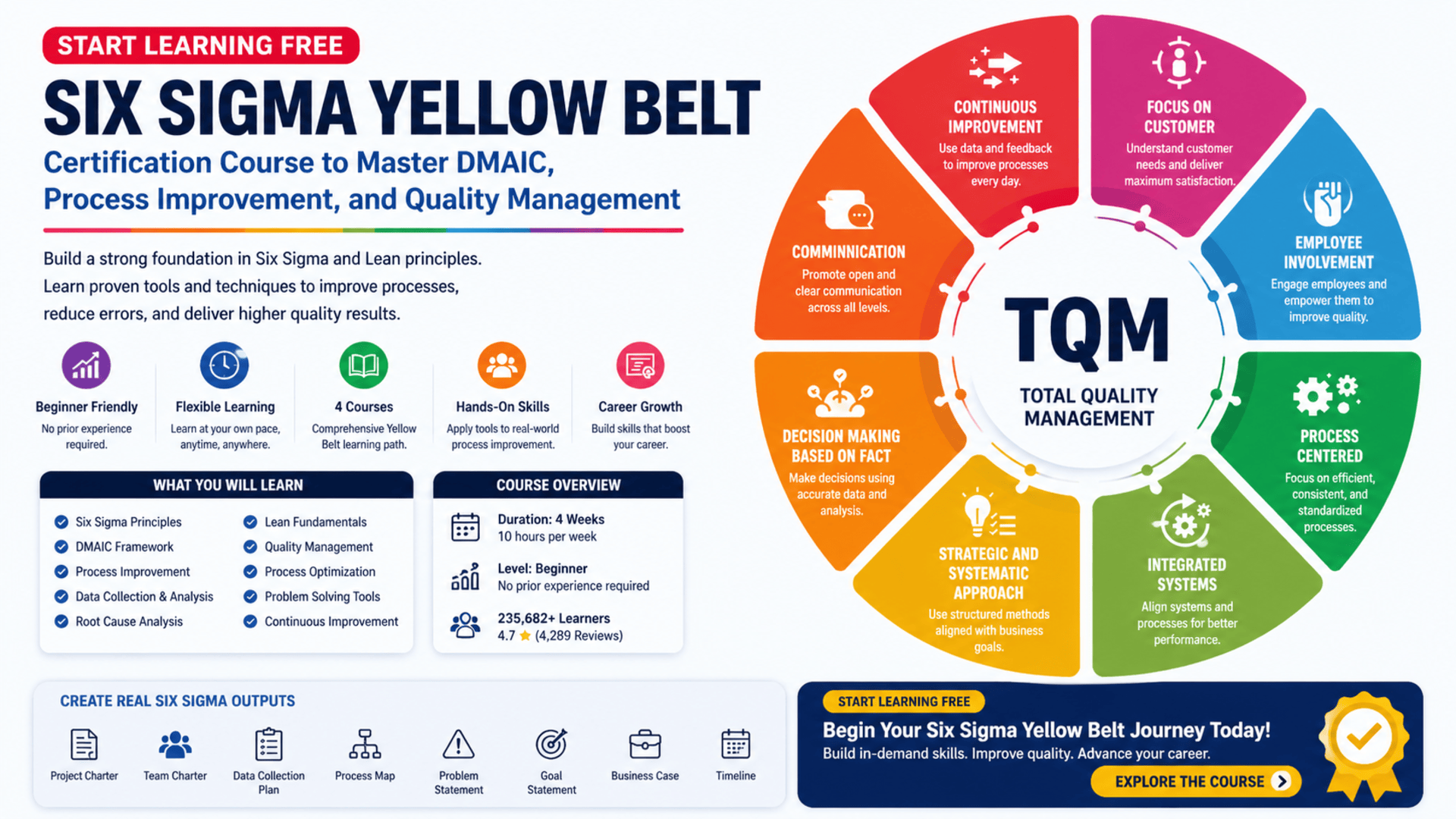
Six Sigma is one of the most valuable skill sets for professionals who want to improve processes, reduce errors, support quality management, and make better business decisions using data. The Six Sigma Yellow Belt level is especially useful for beginners because it introduces the core principles, tools, and mindset needed before moving into more advanced Green Belt or Black Belt training.
This Six Sigma Yellow Belt specialization is designed to help learners understand the basic components of Six Sigma and Lean. It includes a 4-course series, is rated 4.7 from 4,289 reviews, has 235,682 learners enrolled, is marked beginner level, requires no prior experience, and takes about 4 weeks at 10 hours per week with a flexible schedule.
Why This Six Sigma Yellow Belt Course Stands Out
This course focuses on the introductory Yellow Belt level of Six Sigma and Lean. Learners study proven principles and tools used to improve business processes, performance, and quality assurance. The program also explains that Yellow Belt knowledge is the foundation before advancing to Green Belt and then Black Belt learning paths.
The course helps learners build skills in:
✅ Six Sigma methodology
✅ Lean Six Sigma
✅ DMAIC fundamentals
✅ Process improvement
✅ Process optimization
✅ Data collection
✅ Root cause analysis
✅ Quality improvement
✅ Quality management
✅ Statistical thinking
✅ Project management
✅ Kaizen methodology
Course Breakdown
1. Six Sigma Principles
This course introduces the purpose and value of Six Sigma, basic principles of Six Sigma and Lean, roles and responsibilities, and key tools and metrics used in improvement work.
2. Six Sigma Tools for Define and Measure
This course covers the Define phase and introduces the Measure phase of DMAIC. Learners explore project development, project implementation, project management tools, statistics, and data collection.
3. Six Sigma Tools for Analyze
This course covers the Measure phase and parts of the Analyze phase. It introduces process analysis tools, FMEA, measurement system analysis, GR&R, and basic statistics.
4. Six Sigma Tools for Improve and Control
This final course covers the remaining Analyze topics plus Improve and Control. Learners study correlation, regression, hypothesis testing, improvement tools, and control plans for maintaining process improvements.
What You Will Create
By the end of the Course , learners create practical Six Sigma outputs including a project charter, project team charter, data collection plan, process map, hypotheses, problem statement, business case, goal statement, process and scope description, and timeline.
Who Should Take This Course
This course is ideal for:
✅ Beginners in Six Sigma
✅ Quality improvement learners
✅ Project managers
✅ Operations professionals
✅ Business analysts
✅ Team leaders
✅ Manufacturing and service professionals
✅ Anyone who wants to understand Lean and process improvement
How to Start Learning Free This Course
✅ Open the course link
✅ If the page is a Specialization, scroll down and select one individual course inside the program
✅ Open the course you selected
✅ Click Enroll
✅ After signing in, choose Preview instead of Start Free Trial when available
✅ You can now watch available course videos and start learning free
The exact Preview option can vary by course flow, so choose Preview when it appears.
Master DMAIC, Process Improvement, and Quality Management
Build beginner-friendly Six Sigma Yellow Belt skills in Lean methods, data collection, root cause analysis, process optimization, quality improvement, and operational excellence.
How to Start Learning Free
✅ Open the course page
✅ Choose one course inside the specialization
✅ Click Enroll
✅ Select Preview instead of trial when available
✅ Start learning free with available preview videos
Ideal for beginners, quality professionals, project managers, operations teams, and anyone building Lean Six Sigma foundations.