
Object-oriented programming is one of the most important foundations for anyone who wants to become a stronger programmer, software developer, backend developer, systems developer, or computer science learner.
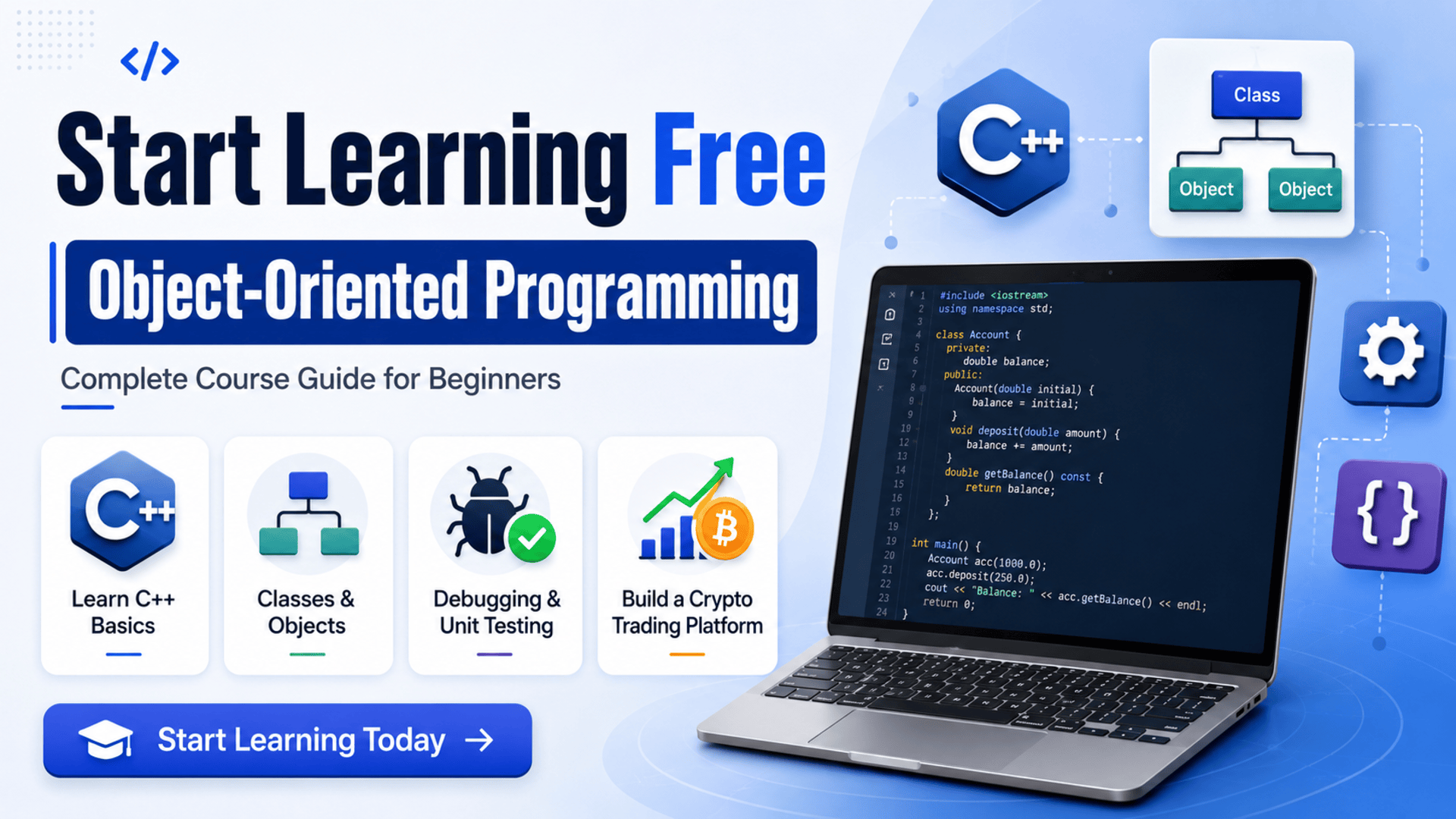
The Object-Oriented Programming Complete Course Guide for Beginners is designed for learners who want to understand how real programs are built using C++, classes, objects, functions, control flow, data structures, debugging, unit testing, and modular software design.
You can start learning free by opening one of the individual courses and checking whether free preview or audit access is available before choosing complete enrollment.
What Will You Learn?
This learning path helps you build practical programming skills in:
- C++ programming
- Object-oriented programming
- Classes and objects
- Object-oriented design
- Functions and modules
- Control flow
- Loops and conditional logic
- Interactive command-line programs
- Data handling
- Data import and export
- File processing
- Pseudocode conversion
- Algorithm implementation
- Exception handling
- Debugging
- Unit testing
- Data validation
- Development environments
- Program development
- Software engineering fundamentals
These skills can help learners understand how larger software systems are planned, structured, tested, and improved.
Courses Included in the Program
1. Introduction to Object-Oriented Programming in C++
Start with the foundations of C++ and object-oriented programming.
This course introduces how to write, compile, and run C++ programs, take user input, print messages to the console, use loops, apply if statements, and create an interactive menu system.
Learners also begin building the foundation of a simplified cryptocurrency trading platform project.
2. C++ Programming: Classes and Data
Learn how C++ uses classes and data to represent real-world information.
This course covers data types, data structures, classes, functions, object-oriented design, program development, and how to model information inside a larger software system.
These concepts are important because object-oriented programming is built around connecting data with behavior.
3. Object-Oriented Programming in C++: Functions
Build stronger programming logic with functions, pseudocode, algorithms, file handling, and exception handling.
This course helps learners convert pseudocode into working C++ code, read data from files, process unreliable data, debug programs, and use built-in functions to improve application behavior.
4. Working with Objects in C++
Go deeper into working with vectors of objects, matching algorithms, exception handling, unit testing, data validation, and test data.
This section helps learners understand how programs can manage groups of objects and apply logic across more complex datasets.
5. Use C++ to Build a Crypto Trading Platform: Final System
Apply your object-oriented programming skills to complete a command-line cryptocurrency exchange simulation.
Learners work toward a functional application that models buying and selling cryptocurrency using real order book data, static and non-static functions, classes, data, and program modules.
Practical Project: Build a Crypto-Trading Platform
One of the strongest parts of this learning path is the project-based structure.
Instead of building only small disconnected programs, learners work toward one larger application: a simplified cryptocurrency trading platform.
Through this project, learners can practise:
- Building command-line applications
- Designing interactive menus
- Modeling real-world trading data
- Creating classes and functions
- Working with order book data
- Reading and processing files
- Handling errors and exceptions
- Testing parts of a program
- Connecting multiple modules into one system
This project approach can help learners understand how object-oriented programming works in a real application.
Who Should Take This Course?
This guide is suitable for:
- Programming learners
- C++ beginners with some coding background
- Computer science students
- Software development learners
- Backend development learners
- Learners who want stronger OOP skills
- Developers moving from simple scripts to structured programs
- Anyone interested in building larger command-line applications
Some programming experience is helpful because the course is designed as an intermediate learning path. You do not need previous C++ experience, but knowing basic programming concepts can help you progress faster.
Why Object-Oriented Programming Skills Matter
Object-oriented programming helps developers build software that is easier to structure, reuse, maintain, and scale.
Instead of writing everything as one long script, OOP encourages learners to organize code around objects, classes, functions, data, and relationships between parts of a program.
These skills are useful for many programming languages and software roles, including C++, Java, C#, Python, backend development, application development, game development, enterprise systems, and technical software engineering.
How to Start Learning Free
Follow these steps to check for free learning access:
- Open the course guide link below.
- Scroll down and select one of the individual courses inside the program.
- Open the course you selected.
- Click Enroll.
- After signing in, choose Preview or Audit instead of Start Free Trial when available.
- You can now watch available lessons, explore course materials, and start learning free.
Free access and preview availability may vary. Certificates, graded assignments, assessments, and full program completion may require paid enrollment. If free preview access is unavailable, check whether financial aid is offered.
Build Practical OOP and C++ Programming Skills
Learning object-oriented programming is not only about memorizing definitions. It is about learning how to design better programs, manage data, create reusable code, debug errors, test logic, and build complete software systems.
This course guide gives learners a structured path to understand C++, object-oriented programming, classes, functions, algorithms, debugging, testing, and practical project development through a full crypto-trading platform example.
Start Learning Object-Oriented Programming
Explore C++, classes, objects, functions, control flow, data handling, debugging, unit testing, and a project-based crypto trading platform example.
Start Learning FreePreview, audit access, and included learning materials may vary.