
Go is one of the most useful programming languages for developers who want to build clean, efficient, scalable, and high-performance applications.
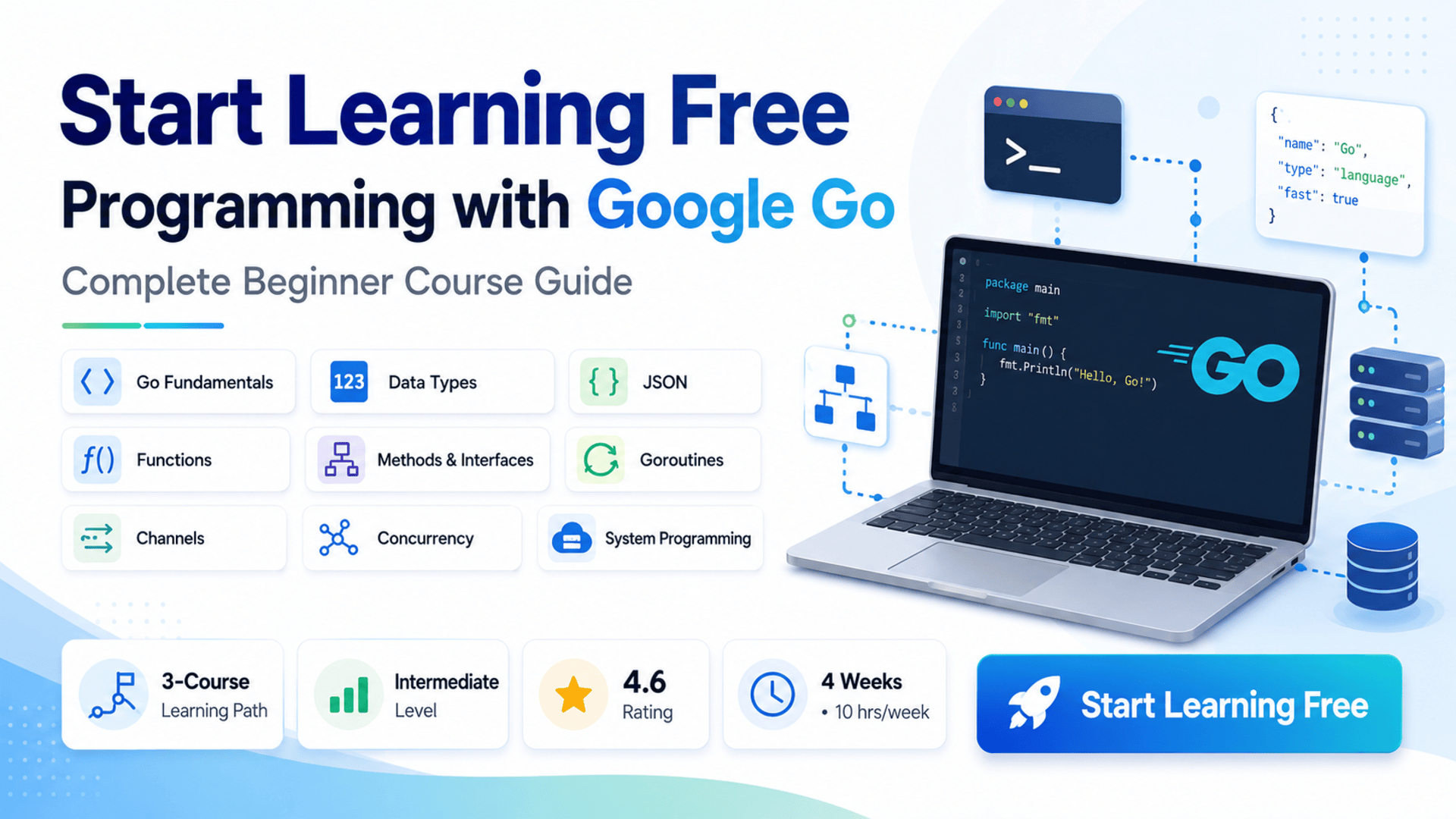
The Programming with Google Go Complete Beginner Course Guide is designed for learners who want to understand Go programming, data types, functions, methods, interfaces, JSON, concurrency, goroutines, channels, and practical application development.
You can start learning free by opening one of the individual courses and checking whether preview lessons are available before choosing complete enrollment.
What Will You Learn?
This learning path helps learners build practical Go programming skills in:
- Go programming fundamentals
- Setting up a Go development environment
- Writing basic Go programs
- Variables and data types
- Composite data types
- JSON data handling
- Remote function calls
- Functions and function types
- Methods and interfaces
- Object-oriented concepts in Go
- Class-like structures and instantiation
- Data structures
- Memory management
- Package and software management
- File input and output
- Data import and export
- Goroutines
- Channels
- Concurrent programming
- Data sharing
- System programming concepts
- Algorithms and computational logic
These skills can help learners understand how Go is used to build efficient applications, backend systems, cloud tools, network services, and scalable software solutions.
Courses Included in the Program
1. Getting Started with Go
Start with the foundations of the Go programming language.
This course introduces the Go development environment, basic program structure, fundamental syntax, data types, composite types, JSON structures, remote function calls, and practical Go programming exercises.
It is a strong starting point for learners who want to understand how Go programs are written and executed.
2. Functions, Methods, and Interfaces in Go
Build stronger Go programming knowledge by learning how reusable code is structured.
This course covers functions, function types, object-oriented ideas in Go, methods, interfaces, class-like structures, object-oriented design, and practical application development.
These topics are important because Go uses simple but powerful patterns to organize code cleanly and efficiently.
3. Concurrency in Go
Go deeper into one of the most important features of the Go programming language: concurrency.
This course introduces goroutines, channels, communication between goroutines, concurrent program design, system programming concepts, data sharing, and example programs that demonstrate how Go handles multiple tasks efficiently.
Concurrency is one of Go’s strongest advantages, especially for developers building scalable applications and backend systems.
Practical Skills You Can Build
During this learning path, learners can practise:
- Writing clean Go programs
- Working with Go data types
- Handling JSON data
- Creating reusable functions
- Building programs with methods and interfaces
- Understanding object-oriented patterns in Go
- Managing packages and code structure
- Using files and data import/export
- Creating concurrent programs
- Working with goroutines and channels
- Solving programming problems with Go
- Building a foundation for backend, cloud, and system programming
These practical skills can help learners move beyond theory and start writing real Go applications.
Who Should Take This Course?
This course guide is suitable for:
- Developers who want to learn Go
- Intermediate programming learners
- Backend development learners
- Cloud development learners
- System programming learners
- Software engineers exploring modern languages
- Python or C developers moving into Go
- Computer science students
- DevOps and infrastructure learners
- Anyone who wants to build efficient and scalable applications
Some previous programming experience is recommended because this is an intermediate-level learning path. Experience with an object-oriented language such as Python, C++, Java, or similar programming languages can be helpful.
Why Go Programming Skills Matter
Go is known for simplicity, performance, clean syntax, strong concurrency support, and efficient application development.
It is widely used in cloud infrastructure, backend services, command-line tools, distributed systems, networking tools, DevOps platforms, and scalable applications.
Learning Go can help developers write cleaner programs, understand concurrency, manage data more efficiently, and build applications that are easier to maintain and scale.
How to Start Learning Free
Follow these steps to check for available preview lessons:
- Open the course guide link below.
- Scroll down and select one of the individual courses inside the program.
- Open the course you selected.
- Click Enroll.
- After signing in, choose Preview instead of Start Free Trial.
- You can now watch the available preview lessons and start learning for free.
Preview availability may vary. Complete lessons, assignments, projects, certificates, and full program access may require paid enrollment. If preview access is unavailable, check whether financial aid is offered.
Build Practical Go Programming Skills
Learning Go is not only about syntax. It is about understanding how to write efficient programs, structure reusable code, manage data, apply interfaces, and build concurrent applications using goroutines and channels.
This course guide gives learners a structured path to start with Go fundamentals and continue toward functions, methods, interfaces, JSON, concurrency, system programming, and practical Go application development.
Start Learning Programming with Google Go
Explore Go fundamentals, data types, JSON, functions, methods, interfaces, goroutines, channels, concurrency, system programming, and practical Go applications.
Start Learning FreePreview availability and included learning materials may vary.