Start Learning Free: Finance for Technical Managers – Master Financial Skills for Better Decision-Making

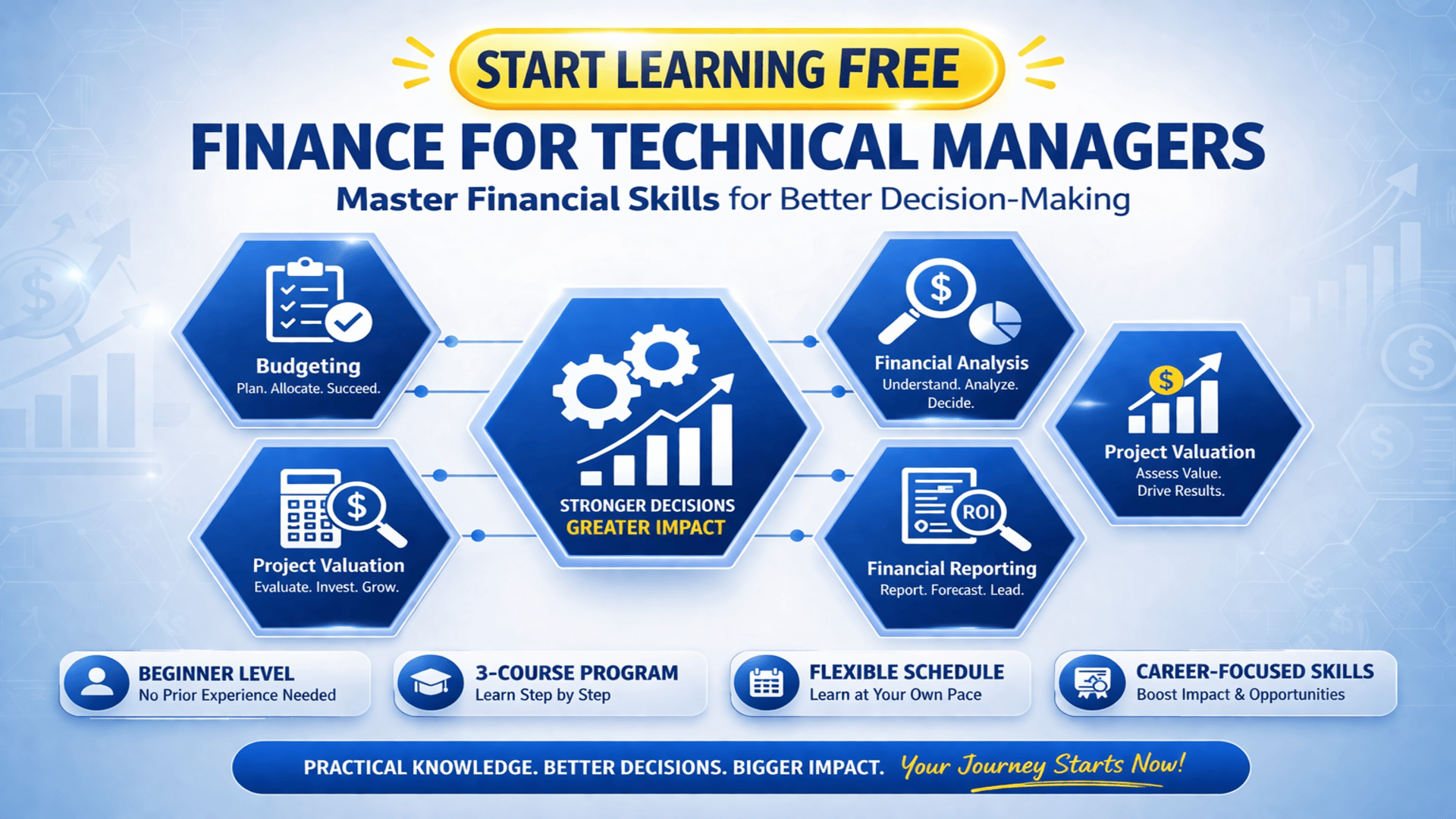
Technical professionals are often trusted to solve complex operational, engineering, and project challenges. But as careers grow, technical decisions increasingly connect to budgets, forecasts, investment choices, financial health, and long-term business value. That is exactly why Start Learning Free: Finance for Technical Managers is such a powerful message. It speaks to professionals who want to strengthen their financial understanding without stepping away from their technical background. This program is designed as a beginner-level, 3-course specialization with a flexible schedule, making it accessible for busy professionals who want structured learning they can fit around work.
If you work in engineering, operations, product, technical project leadership, or any decision-making role where numbers matter, financial literacy can become one of your biggest professional advantages. The ability to read financial statements, understand project value, evaluate investment options, estimate costs, and participate more confidently in budget discussions can elevate your credibility inside any organization. This specialization is built to help learners develop exactly those capabilities through practical finance topics that connect directly to business and project decisions.
Why This Program Matters for Technical Professionals
Many technical managers are excellent at execution but feel less confident when conversations shift toward financial reports, investment logic, budget trade-offs, or the financial viability of a new initiative. That gap can limit influence. The stronger your financial understanding becomes, the easier it is to communicate with leadership, justify recommendations, and support decisions with measurable business value.
This program focuses on the core principles of financial management in a way that is relevant to technical and project-driven roles. Learners explore how to interpret financial statements, calculate financial health, assess new projects using investment metrics, understand capital budgeting, forecast financial outcomes, and even apply key concepts to personal finance and investing. The result is a learning experience that connects technical thinking with real financial decision-making.
What You Will Learn
The specialization is structured to help learners move from foundational concepts into more applied financial thinking. Across the program, learners study how to articulate core finance concepts, interpret company financial statements, calculate financial health, evaluate the financial viability of projects, understand capital budgeting, and apply financial knowledge to investment planning.
The program also develops practical skills in areas such as:
✅ Budgeting
✅ Capital budgeting
✅ Cost estimation
✅ Financial analysis
✅ Financial forecasting
✅ Financial modeling
✅ Financial reporting
✅ Financial statement analysis
✅ Investment management
✅ Project finance
✅ Risk analysis and risk management
For technical managers, this is especially valuable because these are not abstract topics. They shape the way projects are funded, prioritized, measured, and approved.
A 3-Course Learning Path That Builds Real Confidence
One of the strengths of this program is its clear structure. It includes three courses, each focused on an important part of financial decision-making.
1) Product Cost and Investment Cash Flow Analysis
The first course introduces the basics of financial management within organizations. It covers product cost modeling, costing methods, time value of money, spreadsheet-based analysis, and applications to personal financial planning. This course is especially useful for learners who want a practical foundation before moving into project valuation and forecasting. The current program page lists this course at 21 hours.
2) Project Valuation and the Capital Budgeting Process
The second course focuses on financial evaluation techniques used to assess investments and projects. Learners work with concepts such as NPV, IRR, and payback period, and also examine depreciation, taxes, inflation, foreign exchange effects, and project cash flow modeling. This makes it highly relevant for professionals involved in business cases, investment proposals, or project selection decisions. The current page lists this course at 17 hours.
3) Financial Forecasting and Reporting
The third course moves into financial statements, budgets, forecasting, scenario analysis, sensitivity analysis, and sustainability reporting. Learners practice reading key financial documents and determining the financial health of a company through relevant ratios and reporting concepts. This course is listed at 14 hours and supports stronger communication with finance teams and business leadership.
Beginner-Friendly and Flexible
A major reason this program can attract a high number of visitors is that it is not positioned only for finance specialists. The current program details describe it as beginner level, with no prior background knowledge or experience required, although the courses are recommended to be completed in order. It also offers a flexible schedule and is shown as taking about 4 weeks at 10 hours per week. That makes it appealing for working professionals who want to start learning free without committing to a rigid academic schedule.
This matters from an SEO and conversion perspective because many potential visitors are searching for phrases like:
✅ start learning free finance course
✅ finance for managers course
✅ finance for technical managers
✅ beginner finance course for engineers
✅ financial skills for technical leaders
✅ project finance and budgeting course
This topic aligns naturally with those search intents.
Who Should Consider This Program
This specialization is a strong fit for:
✅ Technical managers who want stronger business and financial communication
✅ Engineers preparing for leadership or management roles
✅ Project professionals who need to justify budgets and investments
✅ Product and operations professionals who want to connect technical decisions to business outcomes
✅ Learners who want to start learning free before deciding whether to continue the full program
Because the program also includes a shareable certificate and notes that the credential can be added to a LinkedIn profile, resume, or CV, it can also support professional visibility beyond the learning experience itself.
Start Learning Free: Why This Angle Works
The phrase start learning free is powerful because it lowers friction. Many learners hesitate not because they lack interest, but because they are unsure whether a course will match their goals, learning style, or schedule. Giving them a path to begin without immediate commitment makes the decision easier.
That is why the free-start message should be part of both the article strategy and the on-page call to action. It gives readers a low-risk next step and improves the chance that they will click through, explore the program, and begin engaging with the course content.
How to Start Learning Free
Here is the exact process you wanted included, written in a clean website-friendly style:
How to Start Learning Free This Course
- Open the course link.
- If the page is a Professional Certificate or Specialization, scroll down and select one of the individual courses inside the program.
- Open the course you selected.
- Click Enroll.
- After signing in, choose Preview instead of Start Free Trial.
- You can now watch the course videos and start learning for free.
This guidance is especially relevant here because the program is a specialization made up of individual courses, so learners who want to start learning free should enter through one of the included course pages and look for the preview option.
What Makes This Program Attractive
There are many business and finance courses online, but this one stands out because it is built around the needs of technical professionals. Instead of presenting finance as a purely theoretical discipline, it links financial knowledge to product costs, investment cash flows, project valuation, financial statements, budgeting, forecasting, and practical analysis. The program is taught by Michael J. Readey, Ph.D. and offered by the University of Colorado Boulder, which adds academic credibility to the learning experience.
It also has strong visible learner signals on the current page, including a 4.8 rating from 371 reviews of courses in the program and 9,040 already enrolled at the time of checking. Those indicators can help reassure visitors that this is a serious and well-received learning option.
Build Financial Skills for Better Technical Decisions
Learn budgeting, financial analysis, project valuation, forecasting, and reporting in a structured program designed for technical professionals and future leaders.
Explore the program and follow the free-start steps to preview course content before making a full commitment.