
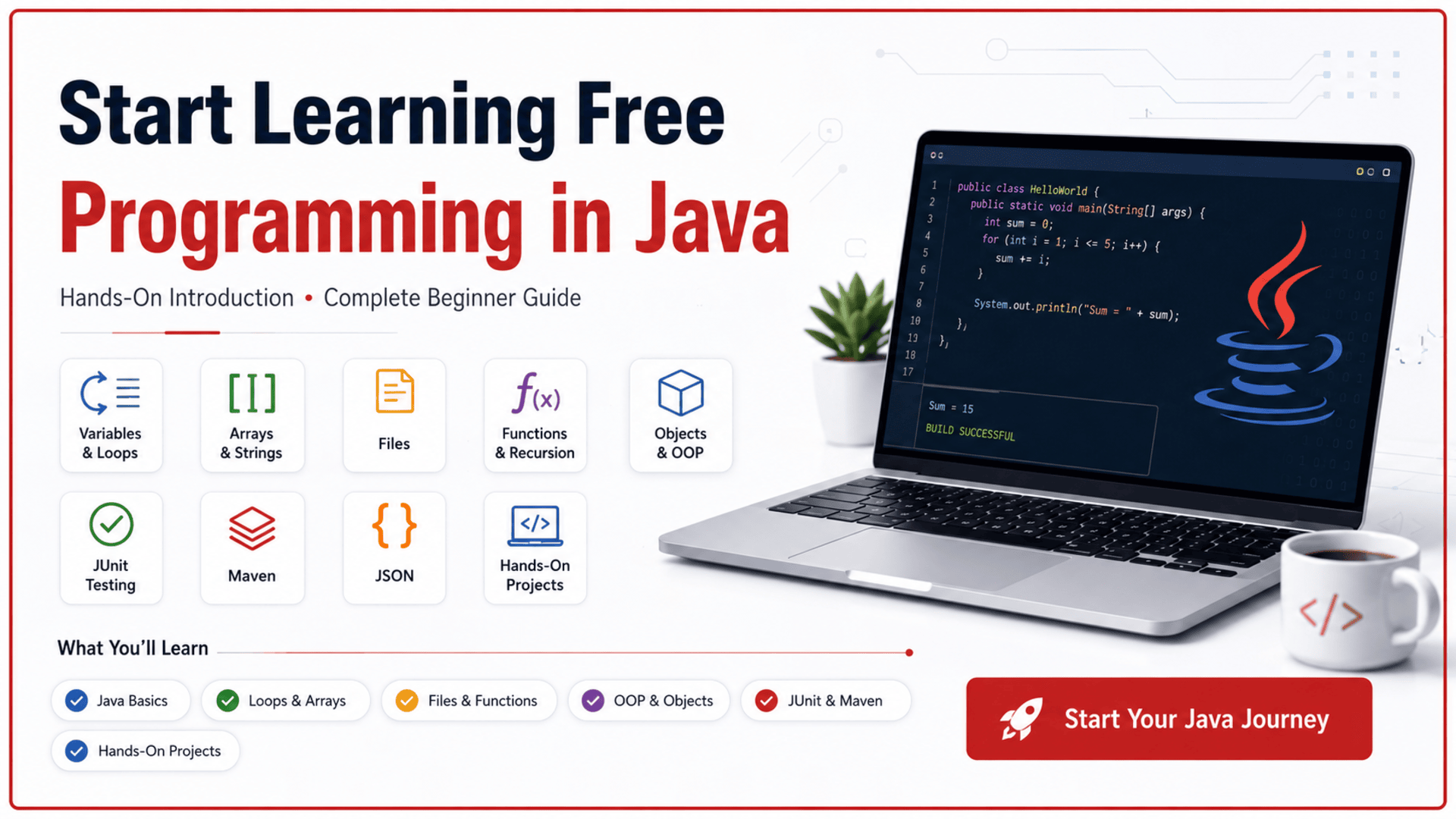
Java is one of the most important programming languages for beginners who want to build a strong foundation in software development, computer science, backend development, application development, automation, and object-oriented programming.
The Programming in Java Hands-On Introduction Complete Beginner Guide is designed for learners who want to start coding with Java through practical exercises, hands-on projects, and beginner-friendly programming concepts.
You can start learning free by opening one of the individual courses and checking whether preview lessons are available before choosing complete enrollment.
What Will You Learn?
This learning path helps learners build practical Java programming skills in:
- Java programming fundamentals
- Variables and operators
- Data storage and manipulation
- Selection statements
- Loops and iteration
- Arrays and strings
- File input and output
- CSV file reading and writing
- Functions and reusable code
- Recursion
- Custom objects
- Classes and object-oriented programming
- Inheritance and encapsulation
- Object-oriented design
- Data validation
- Code style and documentation
- Unit testing with JUnit
- Build tools and Apache Maven
- JSON and web services
- Practical Java projects
These skills can help learners understand how Java programs are written, tested, organized, and improved for real-world use.
Courses Included in the Program
1. Java Basics: Selection and Iteration
Start with the foundations of Java programming.
This course introduces variables, operators, data storage, decision-making, selection statements, loops, iteration, debugging, and basic program logic.
It is a strong starting point for beginners who want to write simple Java programs and understand how programs make decisions.
2. Java Basic Structures: Arrays, Strings, and Files
Build stronger Java skills by learning how to work with structured data.
This course covers arrays, strings, text manipulation, file handling, CSV files, data import, data export, file systems, and practical data storage operations.
These topics are important because many real programs need to read, process, store, and update information.
3. Java Object Basics: Functions, Recursion, and Objects
Go deeper into reusable code and object-based programming.
This course introduces custom functions, recursion, objects, software documentation, object-oriented design, technical documentation, programming principles, and code reusability.
Learners begin to understand how larger programs can be broken into smaller, cleaner, and more reusable parts.
4. Object-Oriented Java: Inheritance and Encapsulation
Learn how to design larger Java programs using object-oriented principles.
This course covers inheritance, encapsulation, class structure, data validation, object-oriented programming, object-oriented design, code reusability, and software architecture basics.
These skills help learners move beyond beginner-level scripts and start thinking like software developers.
5. Core Java
Build stronger professional Java development habits.
This course covers best practices, code style guides, project structure, unit testing, Java Collections, streams, lambdas, DateTime classes, JSON, Maven, build tools, web services, error handling, and package management.
This section helps learners understand how Java is used in more complete development environments.
Practical Projects You Can Build
During this learning path, learners can practise through projects such as:
- Simple Java programs
- Programs that automate repetitive tasks
- File update tools
- Text and CSV processing applications
- Custom object-based programs
- Graphical Java programs
- Animation-style programming exercises
- Unit-tested Java projects
- Programs using external data
- Java applications connected to web-based systems
These projects help learners move from theory to real coding practice.
Who Should Take This Course?
This course guide is suitable for:
- Complete programming beginners
- Java beginners
- Computer science learners
- Software development students
- Career changers entering technology
- Backend development beginners
- Automation learners
- Data science beginners who need programming foundations
- AI learners who want stronger coding skills
- Anyone who wants to learn Java from the ground up
No previous coding or programming experience is required, but comfort using a computer and basic mathematics can help learners progress faster.
Why Java Skills Matter
Java is widely used in enterprise applications, backend systems, Android development, cloud platforms, financial systems, web services, automation tools, and large-scale software environments.
Learning Java helps beginners understand important programming concepts such as logic, data structures, functions, objects, classes, testing, file handling, and software design.
Even if you later learn other programming languages, Java can help you build a strong foundation in how real software is created.
How to Start Learning Free
Follow these steps to check for available preview lessons:
- Open the course guide link below.
- Scroll down and select one of the individual courses inside the program.
- Open the course you selected.
- Click Enroll.
- After signing in, choose Preview instead of Start Free Trial.
- You can now watch the available preview lessons and start learning for free.
Preview availability may vary. Complete lessons, projects, assessments, certificates, and full program access may require paid enrollment. If preview access is unavailable, check whether financial aid is offered.
Build Practical Java Programming Skills
Learning Java is not only about memorizing syntax. It is about understanding how programs think, how data is handled, how logic is written, how reusable code is created, and how software projects are structured.
This course guide gives beginners a structured path to start with Java basics and continue toward arrays, files, functions, recursion, objects, inheritance, encapsulation, unit testing, Maven, JSON, and practical Java application development.
Start Learning Programming in Java
Explore Java basics, variables, loops, arrays, strings, files, functions, recursion, objects, inheritance, JUnit, Maven, JSON, and hands-on programming projects.
Start Learning FreePreview availability and included learning materials may vary.