Start Learning Free: Business Value and Project Management — Deliver Strategic Impact and Measurable Results

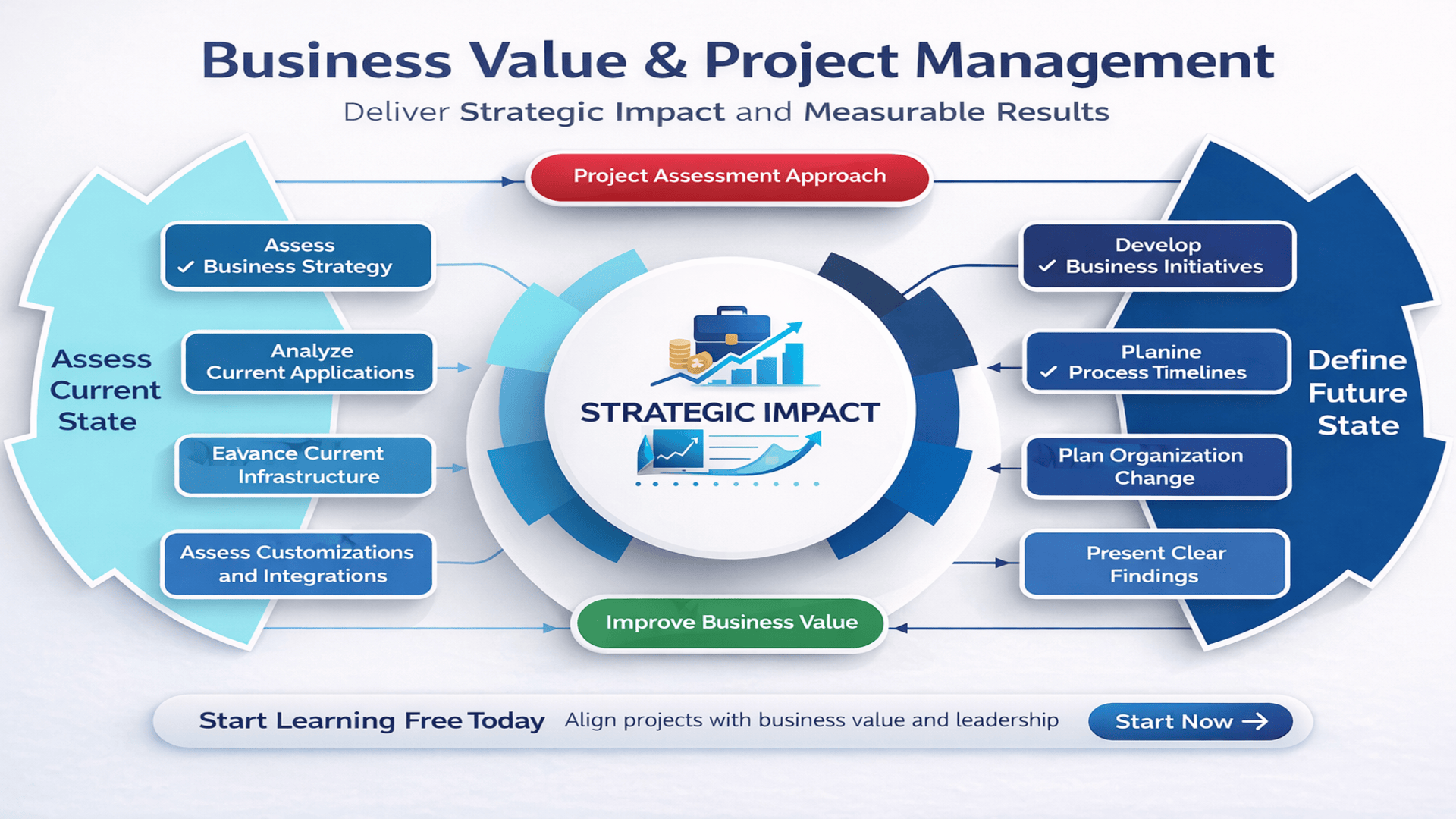
Business success depends on more than finishing projects on time. Strong organizations also need financial understanding, sound leadership, effective organizational design, and disciplined project execution. This program is built around that broader view. It presents a practical learning path that combines business fundamentals with project management so learners can understand how value is created, managed, and delivered inside real organizations.
This Course is a 6-course series from the University of Illinois Urbana-Champaign. It is listed at beginner level, requires no prior experience, follows a flexible schedule, and is estimated at about 2 months at 10 hours per week. The program is taught in English and includes a shareable certificate pathway.
What makes this learning path especially valuable is its mix of three major areas: financial accounting, managing organizations, and project planning and execution. The program says learners will build a more holistic perspective on business fundamentals, understand how to analyze balance sheets and cash flow statements, develop strategies for organizational growth, solve managerial challenges, explore different project planning models, and understand both waterfall and agile approaches to project execution and evaluation.
Why Business Value and Project Management Matter Today
Many professionals learn project management as a stand-alone discipline, but projects do not operate in isolation. They affect budgets, teams, operations, leadership decisions, and long-term organizational performance. That is why this program is useful. It helps learners connect project execution with business value, financial awareness, organizational effectiveness, and change management.
The skills listed for the specialization reflect that broader business focus. They include accounting, accrual accounting, financial statements, cash flows, project management, project planning, project implementation, agile methodology, waterfall methodology, organizational leadership, organizational strategy, organizational structure, change management, and business ethics.
What You Will Learn
The program is organized as a progression through six connected courses. Together, they help learners understand how businesses track value financially, how organizations are designed and managed, and how projects are planned, controlled, and delivered.
1) Financial Accounting: Foundations
The first course introduces the foundations of financial accounting. Learners study accounting information, financial statements, revenue recognition, accrual accounting, and the accounting treatment of short-term assets such as accounts receivable and inventories.
2) Financial Accounting: Advanced Topics
The second course continues with more advanced accounting topics. It covers fixed assets, liabilities, shareholders’ equity, cash flow statements, and broader financial analysis concepts that help learners understand how organizations report and interpret financial performance.
3) Designing the Organization
This course focuses on organizational design and effectiveness. Learners explore common design challenges, analyze the effectiveness of organizational choices, and make recommendations that can improve organizational performance. The skills attached to this course include growth strategies, governance, business strategies, strategic thinking, and ESG-related thinking.
4) Managing the Organization
The fourth course centers on managerial decision-making and organizational challenges. It teaches learners to identify common management issues, apply principles to become more effective managers, analyze management decisions, and recommend ways to improve organizational effectiveness. Skills listed here include organizational change, change management, business ethics, people management, strategic leadership, and influencing.
5) Project Initiation and Planning
This course moves directly into project management. Learners study the project life cycle, develop project management plans, identify labor and material resources, estimate project needs, manage changes to scope, understand team development, and optimize project schedules. Skills listed include project scoping, project planning, risk management, work breakdown structure, stakeholder management, communication planning, waterfall methodology, and agile project management.
6) Project Execution and Control
The final course focuses on control and delivery. Learners create realistic resource plans, evaluate project timing when resources are limited, monitor projects using earned value management, and manage work using the Scrum framework. Skills listed include earned value management, scheduling, sprint retrospectives, resource allocation, project closure, project controls, and project performance.
Skills You Can Build
This program supports a practical mix of business and project skills. On the business side, learners gain exposure to accounting, financial reporting, governance, organizational strategy, leadership, and change management. On the project side, they build familiarity with planning, scoping, estimation, stakeholder management, scheduling, agile, waterfall, earned value management, and project controls. That combination makes the specialization especially useful for learners who want to understand both how businesses operate and how projects deliver measurable results inside them.
Who Should Take This Program
This learning path is a strong fit for:
✔️ Beginners who want a broad introduction to business value and project management
✔️ Professionals who want to understand both business fundamentals and project delivery
✔️ Team members moving into supervisory, coordination, or management roles
✔️ Learners who want a combination of accounting, organizational leadership, and project execution knowledge
✔️ Anyone interested in agile, waterfall, project planning, and business decision-making in one program
Because the specialization is marked as beginner level and explicitly says no prior experience is required, it is accessible to a wide audience.
Learning Experience and Practical Value
The program includes an applied learning project and states that each subject area is followed by an in-depth application and analysis exercise. The central premise is that a well-rounded understanding of multiple business areas is important for growing and sustaining a successful business. That makes the specialization more practical than a narrow, single-topic program.
Start Learning Free: What That Means
The phrase start learning free is powerful for SEO and conversions, but it should be explained clearly and honestly.
The program page includes an Enroll for free entry point, and the specialization is built from individual courses. The most accurate way to present this is that learners can begin by opening one of the individual courses inside the series and using the available Preview option where offered. Full graded work, full program completion, and certificate features may require full enrollment.
So the best conversion-friendly message is this:
You can start learning free by opening one of the individual courses inside the program and choosing the available Preview option to begin exploring the course content.
How to Start Learning Free
Use this guide:
✔️ Open the program page
✔️ If the page is a specialization, scroll down and select one of the individual courses inside the program
✔️ Open the course you selected
✔️ Click Enroll
✔️ After signing in, choose Preview instead of Start Free Trial
✔️ You can now watch available course content and start learning free
That approach aligns with how the platform describes free preview access for many business management and project management courses.
Why This Program Stands Out
This program stands out because it does not treat project management as a narrow scheduling skill. It connects project delivery to financial understanding, organizational design, management effectiveness, and business growth. That broader structure can help learners understand not only how to run projects, but also how projects fit into the bigger picture of organizational success.
Career and Business Value
Professionals who understand both business value and project management can contribute more effectively to planning, execution, budgeting, coordination, and organizational improvement. This specialization supports that by combining accounting literacy, leadership and organization topics, and project planning and control methods in one pathway. For some learners, the biggest value will be stronger project execution. For others, it will be the ability to connect projects with financial and organizational outcomes more clearly.
Build Business Value Through Smarter Project Management
Learn financial accounting, organizational leadership, project planning, agile, waterfall, and project controls in one practical learning path designed for real business impact.
Open the program, choose one of the individual courses, click Enroll, then select Preview to begin with available free content.