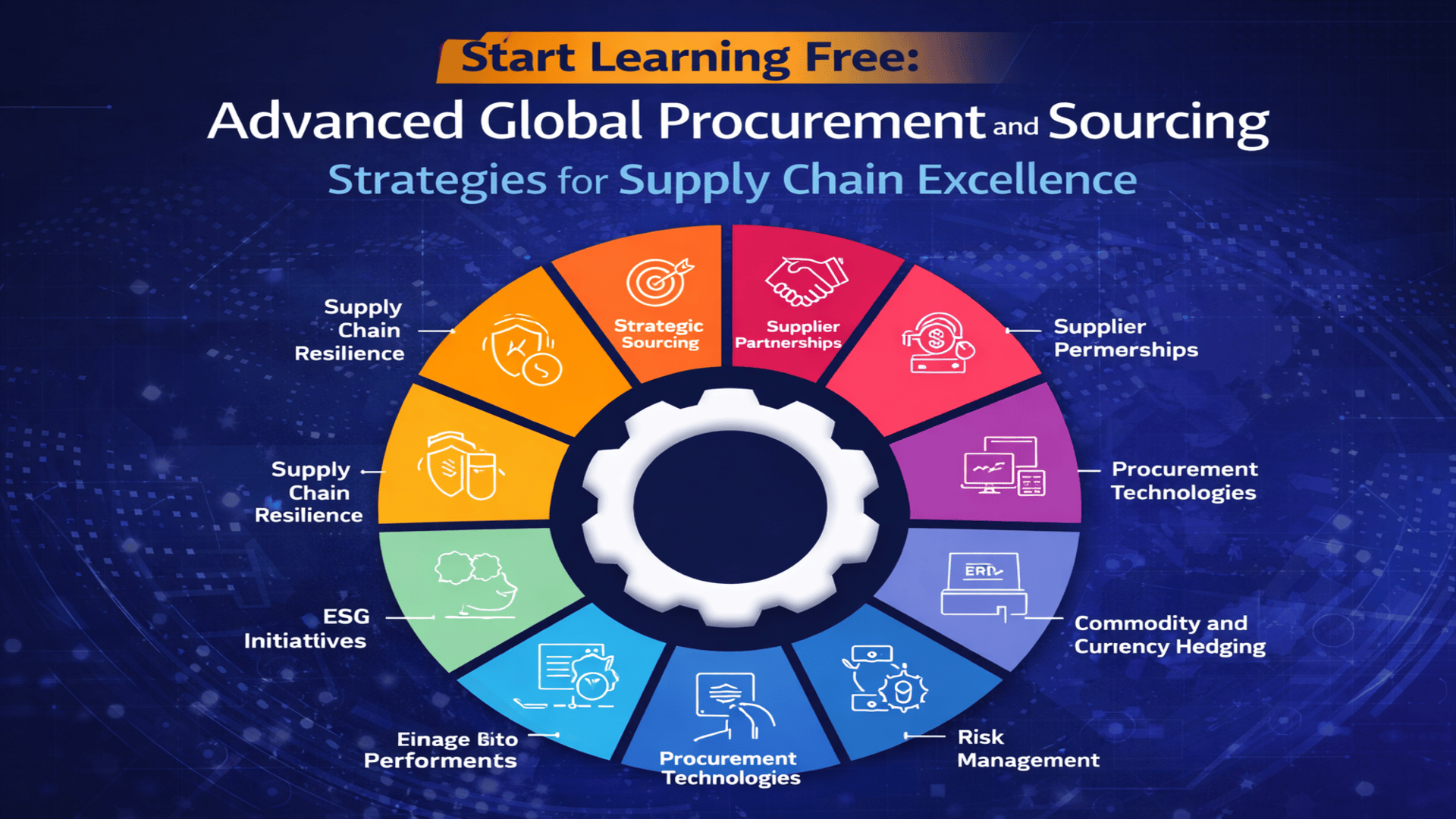
Start Learning Free: Advanced Global Procurement and Sourcing Strategies for Supply Chain Excellence

Procurement has moved far beyond purchase orders and supplier price comparisons. In a volatile global market, procurement teams are expected to reduce risk, build resilient supplier networks, improve operational efficiency, leverage technology, and create measurable business value.
Coursera’s Advanced Global Procurement and Sourcing is positioned for that higher-level role: it is offered by Rutgers University, taught by Don Klock, and designed for learners who want to build the skills needed to run a world-class procurement organization. Coursera lists it as a 7-course series, intermediate level, with a flexible schedule and an estimated pace of 4 weeks at 10 hours per week on the main page.
That makes this program especially relevant for professionals who already understand procurement basics and now want to move into more strategic work. The specialization focuses on procurement organization design, supplier partnerships, post-Covid sourcing strategy, hedging, procurement technology, ESG, and supplier diversity. In other words, it addresses the exact themes that define modern supply chain excellence.
What is the Advanced Global Procurement and Sourcing
According to Coursera, this specialization is intended for experienced procurement people who want to develop the skills to run a world-class procurement department. The program states that learners will study how to operate an efficient and effective procurement organization, create stronger supplier partnerships, reduce risk through commodity and currency hedging, and use technology to improve procurement performance. It also includes newer strategic areas such as Environmental, Social, and Governance (ESG) and Supplier Diversity.
Coursera also highlights an applied learning project component. In addition to videos, readings, and assessments, learners work through “real life” cases that are peer-assessed, giving the program a practical angle rather than making it purely theoretical.
What you will learn
The specialization page lists a broad set of skills connected to procurement leadership and supply chain strategy, including procurement, purchasing, strategic sourcing, supplier relationship management, supplier quality management, risk management, business risk management, KPIs, organizational structure, ERP, RPA, ESG, and supply chain management.
In practical terms, the program teaches you how to:
➡️ Build and manage an effective procurement organization
➡️ Integrate procurement more closely with business strategy and suppliers
➡️ Define meaningful procurement KPIs and improve performance measurement
➡️ Evaluate sourcing risks in a post-Covid global environment
➡️ Use strategies such as China +1, nearshoring, and reshoring
➡️ Understand total cost of ownership in sourcing decisions
➡️ Develop stronger supplier partnerships
➡️ Use commodity and currency hedging as risk management tools
➡️ Leverage ERP, procure-to-pay tools, and enabling technologies such as AI, ML, and RPA
➡️ Understand procurement’s role in ESG and supplier diversity initiatives.
Program structure
Coursera lists the specialization as a 7-course series with these components:
✅ Introduction and Course Outline
✅ Procurement Organizations
✅ Global Procurement in a Post Covid World
✅ Supplier Partnerships
✅ Commodity and Currency Hedging
✅ Leveraging Technology to Achieve Results
✅ Special Topics
The course descriptions show why this specialization is attractive for professionals who want strategic depth:
Procurement Organizations focuses on integrating procurement into the business, designing procurement organizations, setting policy and procedures, establishing KPIs, and managing talent.
Global Procurement in a Post Covid World covers the logic and challenges of worldwide sourcing, supply chain disruption lessons, supplier quality and risk management, and mitigation strategies such as China +1, nearshoring, reshoring, and TCO analysis.
Supplier Partnerships explains why partnerships matter and includes a partnership model reportedly used successfully in more than 150 companies.
Commodity and Currency Hedging introduces hedging as a procurement risk management technique and explains both commodity hedging and currency hedging.
Leveraging Technology to Achieve Results covers ERP, procure-to-pay tools, and newer technologies such as AI, ML, and RPA to make procurement more efficient and more strategic.
Special Topics and Specialization Wrap-up addresses ESG and supplier diversity, then reviews the specialization and ends with a final assessment.
Who should take this course
Coursera describes the program as intermediate level and says some related experience is required. In the FAQ, the page says it is helpful, though not strictly necessary, to have completed the original Global Procurement and Sourcing Specialization or to have basic procurement knowledge, and it notes that most courses are geared toward more experienced procurement professionals.
This makes the specialization a strong fit for:
✔️ Procurement professionals ready to move into more strategic work
✔️ Supply chain leaders who want stronger sourcing and supplier management skills
✔️ Managers responsible for procurement performance and cost reduction
✔️ Professionals who want to modernize procurement with technology
✔️ Teams working on supplier partnerships, ESG, or risk mitigation.
Why this course is valuable for business growth
A strong procurement function directly affects cost, resilience, risk, supplier performance, and long-term competitiveness. This specialization is valuable because it does not stop at tactical purchasing. It teaches learners how to create competitive advantage through procurement organization design, strategic partnerships, hedging, digital enablement, and performance management. Those topics are consistently tied to efficiency, value creation, and cost reduction in the program description and FAQ.
The technology module is especially useful for modern organizations because it connects procurement with ERP, automation, AI enablement, business process automation, and operational efficiency. That makes the course relevant not only for traditional sourcing professionals, but also for leaders trying to modernize procurement as part of a larger digital transformation effort.
Start Learning Free: how to access the course
Your marketing angle around “Start Learning Free” is strong because it reduces friction and increases clicks. But there is an important accuracy note: Coursera’s FAQ for this specialization says “No, you cannot take this course for free” and adds that learners who cannot afford the fee can apply for financial aid. The same page also says learners can enroll in a single course from the specialization.
So the safest way to present your guidance is this:
How to Start Learning Free this course
- Open the course link.
- If the page is a Professional Certificate or Specialization, scroll down and select one of the individual courses inside the program.
- Open the course you selected.
- Click Enroll.
- After signing in, choose Preview instead of Start Free Trial if that option appears.
- You can then begin learning the available content for free, or apply for financial aid if preview is not available.
That wording stays aligned with your conversion goal while remaining accurate to the official Coursera information.
Why “Start Learning Free” can help SEO and conversions
From an SEO and marketing perspective, Start Learning Free works well because it matches high-intent search behavior. People often search with phrases that combine “free,” “course,” and a specific career skill. It also performs well as a click trigger because it lowers perceived risk. In this article, the phrase is naturally connected to procurement, sourcing, supply chain excellence, risk management, and supplier strategy, which helps keep the content relevant both for users and search engines.
For on-page SEO, this article also supports ranking by using the core phrase Advanced Global Procurement and Sourcing in the title, introduction, subheadings, and body text, while adding semantically related terms like strategic sourcing, supplier relationship management, procurement technology, supply chain management, ESG, and supplier diversity based on the official course page.