Start Learning Free: Construction Management Fundamentals to Build Strong Project Skills and Career Growth

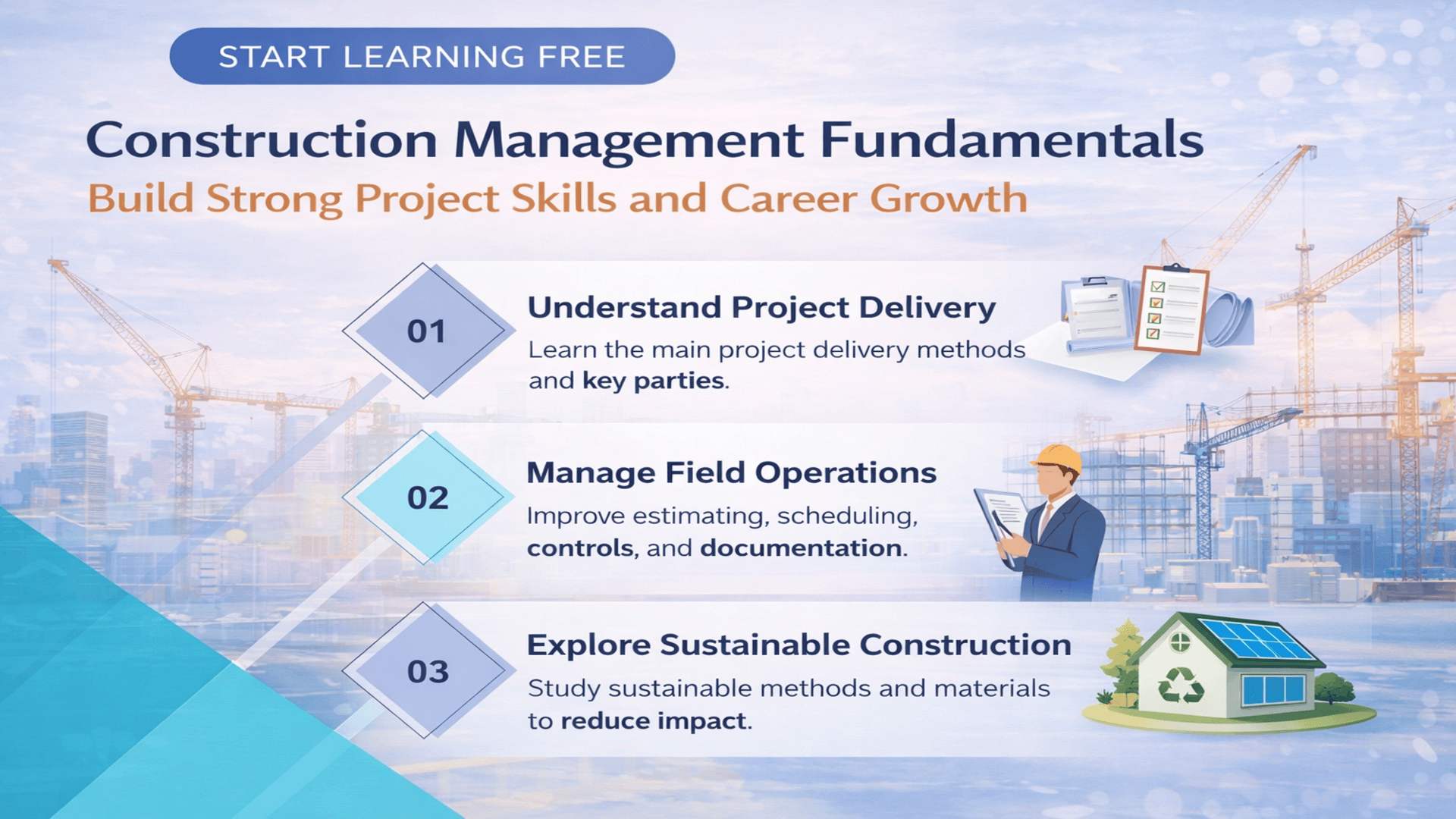
Construction projects depend on much more than technical execution. They require professionals who understand how projects are organized, how delivery methods and contracts shape outcomes, how field operations are managed, how schedules and estimates evolve, and how sustainability is becoming part of modern project delivery. That is why learning construction management fundamentals can make such a strong difference for both career growth and real project performance. This specialization is built to help learners understand those essentials in a structured, beginner-friendly way.
According to the official program page, this specialization is offered by the University of Maryland, College Park and includes a 4-course series designed for beginners with no prior experience required. It is listed as taking about 4 weeks at 4 hours a week, includes a flexible schedule, and leads to a shareable certificate. The page also notes that more than 4,373 learners are already enrolled and that the courses in the program hold a 4.8 rating from 131 reviews.
One reason this program stands out is that it focuses on real construction management responsibilities rather than abstract concepts. The specialization description explains that construction management is the application of knowledge, skills, tools, and techniques to the many activities required to complete a project successfully. It also emphasizes that successful construction managers must understand the roles of owners, designers, developers, government agencies, stakeholders, legal parties, insurers, financial institutions, and subcontractors while using modern management tools to move projects forward in a timely and cost-effective manner.
Why Construction Management Fundamentals Matter
Professionals in construction often advance when they become more capable across the full project environment, not just within one technical task. A strong understanding of project roles, project delivery methods, contracts, scheduling, cost management, controls, safety, and sustainability can help a professional contribute more effectively and make better decisions.
The official page highlights this broad value directly in the learning outcomes. Learners are introduced to construction management preparation, planning, design, engineering, business, and technical practices used in the industry. The program also explores future trends, industry opportunities, different sectors of the field, project delivery methods, and sustainable methods, materials, building systems, and controls.
That matters because employers often need people who can see the wider project picture. When someone understands how contracts affect execution, how schedules guide coordination, how controls support performance, and how sustainability influences design and delivery, that person becomes more valuable to teams and projects.
What You Will Learn
This specialization is designed to help learners build practical knowledge across several key areas of construction management. The program page lists skills including change control, construction accounting, construction engineering, construction estimating, construction management, contract management, cost management, engineering management, leadership development, occupational safety and health, project controls, project coordination, project implementation, project management, project risk management, project schedules, scheduling, sustainable architecture, sustainable technologies, and timelines.
Beyond the skill list, the page also explains that learners will develop a deeper understanding of how the industry works in practice. That includes learning about project planning, delivery methods, construction-phase organization, administrative tools, project documentation, legal and dispute-related issues, safety procedures, and modern sustainable construction methods.
Another valuable point is that the specialization includes applied learning through knowledge checks at the end of lessons, quizzes at the end of each week, and a cumulative final exam. That means the learning path is not only informational. It is also built to test understanding and reinforce practical concepts.
The 4 Courses Inside the Program
1) The Construction Management Industry and Profession
The first course is listed at 9 hours and introduces core industry and project leadership concepts. According to the course page, learners explore how to lead construction projects by managing key roles such as owner, designer, and construction manager effectively. The course also covers using project management tools to plan, execute, and control construction lifecycles, applying communication and leadership skills to improve coordination and construction quality, and analyzing project feasibility, costs, and construction methods to support stronger decision-making.
2) Construction Management Project Delivery Methods & Contracts
The second course is listed at 8 hours and focuses on delivery methods, contracts, risks, and collaborative project execution. The page says learners assess and recommend project delivery methods, analyze project risks and contract options, apply collaborative design and value engineering, and organize and manage the construction phase more effectively. These are important skills for professionals who want to improve reliability and strategic thinking in project environments.
3) Construction Management Field Operations and Admin Tools
The third course is listed at 8 hours and focuses on field operations, estimating, scheduling, controls, records, law, and safety. The course description explains that learners study how estimates evolve over a project, how schedules are used to track work, how project control supports owner objectives, and how administrative tools are used to manage, control, and document the construction management process. The course also reviews legal rules affecting construction management, alternative dispute resolution methods such as arbitration and mediation, and important safety procedures.
4) Sustainable Construction Management
The final course is listed at 7 hours and focuses on sustainable construction from conception to completion. The course description covers sustainable methods and processes, building information modeling, laser scanning, drones, the critical path method, sustainable materials and systems, energy management, renewable energy, stakeholder involvement, green building certifications, disaster management procedures, emissions reduction, and current trends in sustainable construction management.
Who Should Take This Program
This specialization is a strong fit for beginners who want a clear introduction to construction management, as well as professionals who want a more structured understanding of how projects are delivered and controlled. Because the official page labels it as beginner level with no prior experience required, it is accessible for learners entering the field or trying to strengthen their foundation.
It can also be valuable for construction professionals, project coordinators, civil engineering learners, supervisors, and anyone who wants stronger knowledge in contracts, delivery methods, field operations, scheduling, documentation, safety, and sustainable construction practices. That mix makes it useful not only for learning the basics, but also for improving professional credibility and long-term growth.
How This Program Supports Career Growth and Project Skills
Career growth in construction often comes from becoming more useful across a wider range of project activities. Someone who understands project roles, contracts, risks, schedules, controls, documentation, and sustainability can support better outcomes and communicate more effectively with different project participants.
This program supports that kind of development by combining practical project knowledge with business, legal, communication, and sustainability themes. The course descriptions show that learners are exposed to feasibility analysis, value engineering, project coordination, project controls, scheduling, documentation, dispute resolution, safety assurance, and sustainable project development. That broad mix can help learners become more capable contributors in real project environments.
Start Learning Free: How to Begin
One of the strongest marketing angles for this program is simple: readers can start learning free. That phrase is effective because many people want to explore a learning path before committing more fully. For a specialization like this one, the practical path is to open the main program page, scroll down to one of the individual courses included in the specialization, open that course, click Enroll, sign in, and choose Preview instead of Start Free Trial when that option is available. That gives learners a way to begin watching course content and exploring the material right away. The program page clearly shows that it is a specialization made up of individual courses, which supports this access path. (Coursera)
How to Start Learning Free
✅ Open the course link
✅ If the page is a Professional Certificate or Specialization, scroll down and select one of the individual courses inside the program
✅ Open the course you selected
✅ Click Enroll
✅ After signing in, choose Preview instead of Start Free Trial
✅ You can now watch the course videos and start learning free
Build Strong Construction Management Fundamentals for Real Project Success
Learn project delivery methods, contracts, field operations, scheduling, controls, documentation, and sustainable construction practices in one practical learning path.
Explore the program and begin with the preview option available through an individual course inside the specialization.